

Why the structure of a ‘knowledge rich’ curriculum matters
By Rosemary Hipkins

In a recent blog post for NZARE (New Zealand Association for Research in Education), Graham McPhail said this:
A knowledge-rich curriculum is organised around key concepts that are connected to each other. This helps students see how ideas in the subject fit together, rather than learning isolated facts. It’s like coming to see how the parts of a jigsaw puzzle fit together to create an overall view of something. When students have access to such a view, it is more likely to lead to deeper understanding. Good curriculum design would give us a clear view of what this structure looks like in each subject.
This is an enticing explanation, but I wonder how many of the new curriculum drafts walk this talk? I’m going to illustrate my concern in the context of Year 11 science and Year 12 and 13 biology because those are the subjects where I might create the richest conceptual jigsaws myself. I hope what I have to say might be useful for those thinking about the structure of other subjects and learning areas.
If you read my last AEC post, you might be wondering why I am so concerned that science and biology largely reflect the structure and concepts of the curriculum I first taught early in my career. Back at the start of the 1970s, curriculum knowledge was structured in a way that mirrored the thinking of most biological scientists at the time. Mid-century breakthroughs had established how DNA works. These new concepts resolved tensions between theories of inheritance and theories of evolution. Bringing these previously separate lines of biological inquiry together created a powerful new type of knowledge jigsaw called the ‘modern synthesis’. Ecology was still seen as a separate branch of biology and was taught and assessed quite separately. The Level 5 Biology drafts just released still largely reflect this structure. Content is organised into three strands: biological systems; inheritance and evolution; and ecology.
Meanwhile the biological sciences have taken huge conceptual leaps forward. So much has changed that the modern synthesis is no longer seen as an adequate way to bring the theoretical threads together. Scientists now realise that ecology is closely intertwined with genetics and evolution, and a new synthesis is needed. This implies that a new organising structure might be needed for the curriculum too. With this thought in mind, I recently did an AI search which asked: “Looking around the world, what do national curriculum frameworks consider to be the “big ideas” of biology for senior secondary school?”
Drawing on examples from a range of nations, ChatGPT summarised the high-level shift as shown in the box below. I have reformatted, so the words take up less room, but this is verbatim from the search engine.
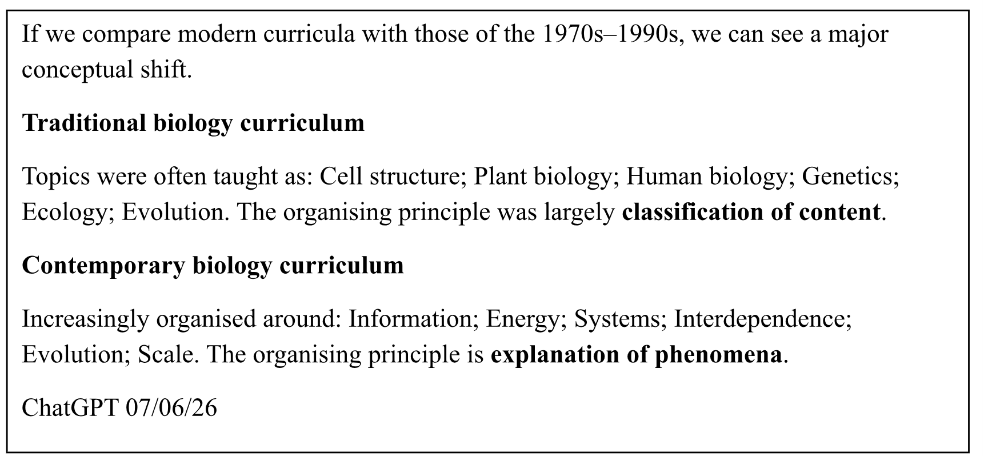
The structure of our new science and biology curricula reflects the traditional organisation sketched above. This seems like a missed opportunity to move with global curriculum trends, and to keep up with contemporary science thinking. But if we were to move to a new structure, we would first need to debate the types of phenomena we might want students to be able to explain, and shape these as ‘big ideas’. These ideas would then need to frame the way in which specific concepts interlocked to make up the clear picture of the knowledge jigsaws we might now envision.
In drawing the primary search to a close, ChatGPT made the following comment:
Given your interest in curriculum paradigms and complexity, it would also be interesting to compare these biology “big ideas” with the big ideas emerging in contemporary ecology. There, the shift toward complexity is much more explicit, and it raises questions about whether senior school biology curricula are keeping pace with changes in the biological sciences.
The final sentence is interesting. It seems that our curriculum developers are not alone in struggling to keep up with where science knowledge is going! I asked ChatGPT to make the suggested comparison between the big ideas of contemporary ecology and the big ideas reflected in national curricula. This secondary search provided a lot of detail. Biology teachers might find this useful but for my purposes today the concluding high-level summary will suffice. It’s in the box below, again verbatim,
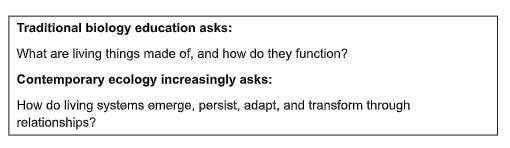
Notice the shift from ‘things’ to ‘systems.’ Contemporary biological thought does not foreground individual organisms and their functioning. The focus has shifted to relationships, interdependence, and all the non-linear dynamics that complexity scientists are continuing to explore.
This comment also adds something new and important to this discussion of ways to structure a knowledge rich curriculum. The basic facts set out in the new drafts are still important (though I would argue there are too many and there is too much emphasis on technical details). A new structure would organise this ‘content’ differently, not replace it. This is a both/and argument not an either/or one. If we want to create new and engaging knowledge jigsaws, it seems clear that we first need to shape concepts as explanatory ideas, not just present curriculum content as facts.
Let’s try and work this through with a concrete example. In the 20th century the curriculum was broadly organised around ‘things to know about’ (i.e. ‘topics’ as per the first box above). But 21st century biologists have described so many complex entanglements between different types of organisms that the traditional structure no longer works to convey their rich insights. Relationships are now seen as fundamental units for understanding biology. This is implied by the contemporary examples in the first box— you can’t explain intertangled relationships without drawing on the contemporary ideas such as information, energy, scale, interdependence and so on. Any new structure would need to encompass the overarching big idea that relationships are the primary driver of everything that happens in the living world.
This shift to a focus on relationships has huge implications for how we think about topics. There are so many wonderfully rich examples waiting for young people to explore—topics that I think they would find highly engaging and that have important citizenship implications. Think for example about recent discoveries of microbiomes. Scientists no longer think of us (and indeed other living creatures) as discrete individuals. Each of us is an interdependent collective of our own cells and the teeming myriads of microscopic organisms that make up our personal microbiome. The mix of micro-organisms is personal to each of us (ongoing science inquiries are finding ever more species) and has significant impacts on our wellbeing. Recent research has demonstrated that the adolescent years are a highly sensitive time for the ongoing development of a healthy ‘gut-brain axis’ in which the microbiome plays an important role. Many teenagers are learning about this phenomenon on social media platforms such as TikTok. Wouldn’t we prefer that that they make important life decisions based on informed biological thinking rather than the self-interested postings of social media influencers?
Notice how my brief explanation foregrounds relationships and complex entanglements, between our body organs (gut/brain) and between bodies (us/microbes) with emergent health implications. But the current curriculum structure doesn’t cue this dynamic and interconnected way of thinking. For year 11, microbiomes are presented in an impersonal way as something to know about:
The microbiome consists of communities of organisms that live in and on the body and may have mutualistic relationships with the host.
And:
Antibiotics act on bacterial populations and can alter microbial communities in the body.
Also in year 11, the presence of soil microbiomes could be inferred from one bullet point in the very detailed list of ‘things to learn about soil’ but the reference is tangential and located in a totally separate curriculum ‘box’ to the mention of microbiomes above.
Oxygen is essential for root respiration, and the activity of beneficial microbes, which help break down organic matter into nutrients plants can absorb.
Structured like this, microbiomes continue to be things to be known about, rather than envisioned as dynamic collectives that have huge implications for how we live our own lives, and how we live with greater awareness of the impact of our actions on other living collectives. If we believe that this type of deeper and more interconnected understanding matters, then the jigsaw pieces are currently scattered, and the jigsaw picture is out of focus.
I realise that it would be impossible to structure a curriculum in a way that draws attention to every potential example of interconnectedness. That’s not what I am suggesting here. I do think we need to go back to the drawing board and ask how we want our young people to ‘be’ and to act in the world as a consequence of their science learning, and then what types of rich conceptual pictures might best serve those purposes.
I also need to note an important limitation in my discussion here. I have focused on how we structure science concepts per se. But learning about science as a knowledge system is also important, and this is an integral aspect of developing enduring competencies for life beyond school. I suspect that a richer and more focused conceptual framing—one that better reflects contemporary science—has the potential to open new pedagogical spaces so that all these curriculum aims could be achieved in a more coherent and manageable way. Again, this would be a both/and design strategy, not one of positioning ‘knowledge’ and ‘skills’ as oppositional binaries between which we must choose.
It would be unreasonable to expect individual teachers to keep up with all the knowledge advances in all the discipline areas they need to teach, but I do think we could expect that curriculum developers who claim subject expertise should be able to envision and build new structures that at least show awareness of the huge shifts happening in the sciences, and of the impact of Ai on how we generate and structure knowledge. These structures would then guide and support teachers in ways that help them see how the all the important parts of the curriculum interlock (including between traditional learning areas) as well as how profoundly science thinking has shifted in this century. Unless curriculum writers do this level of deep conceptual interlinking, I don’t see how a curriculum can claim to be knowledge rich on the terms Graham McPhail describes above.
Superb. Thank you. This thinking was very much present in Kia Eke Panuku and the Center(re) for Ecoliteracy, and is the mainstay of thinking, teaching and learning in EfS. If only this rippled so smoothly though the entire curriculum ...