When Curriculum and Progress Markers tell different stories

The refreshed mathematics and statistics curriculum sets out an ambitious vision for learning in Aotearoa classrooms. It provides detailed descriptions of the knowledge and practices students should develop across the strands of number, algebra, geometry, measurement, statistics, and probability. For each year of schooling, the curriculum outlines both the mathematical ideas students should encounter and the ways they should engage with those ideas through reasoning, representation, and problem solving.
Alongside the curriculum, the Ministry of Education has also released progress markers intended to describe what “proficient” students should know and be able to do at the end of each year level.
In principle, this type of guidance can be helpful. Teachers often ask for clarity about what progress should look like across the years of schooling. However, when the progress markers are compared closely with the curriculum, a problem becomes apparent: the two documents do not always describe the same expectations or signal the same level of mathematical demand.
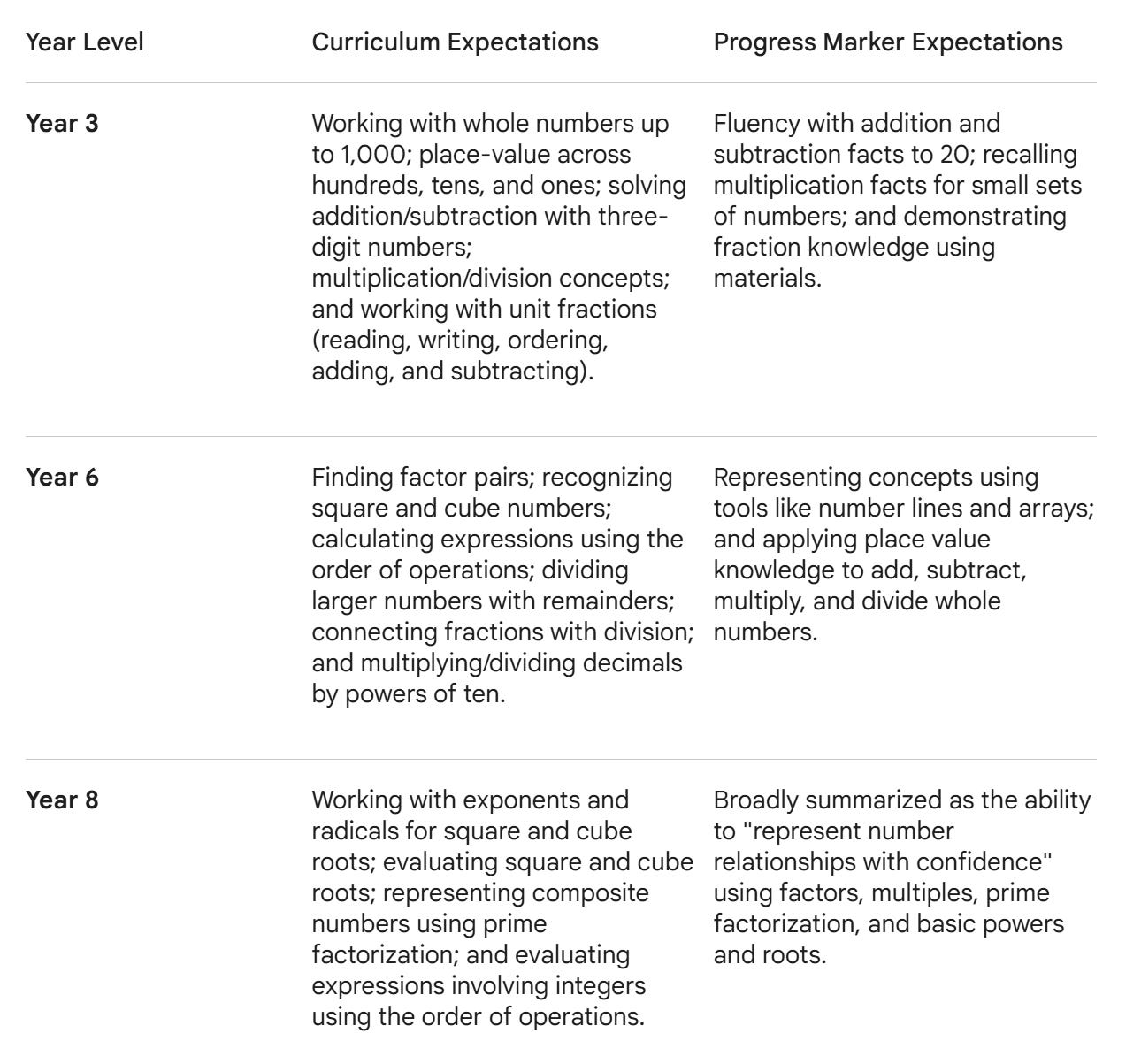
Consider the number strand. In Year 3, the curriculum describes learning that includes working with whole numbers up to 1,000, developing place-value understanding across hundreds, tens, and ones, and solving addition and subtraction problems involving three-digit numbers. Students are also expected to engage with multiplication and division concepts and read, write, count, order, compare, add, and subtract unit fractions.
The Year 3 progress marker, however, emphasises a different set of expectations. It highlights students being fluent with addition and subtraction facts to 20, recalling multiplication facts for small sets of numbers, and demonstrating fraction knowledge using materials. These expectations are not incorrect, but they represent a more limited range of the learning described in the curriculum.
This pattern is not confined to the early years. Similar differences between the curriculum and progress markers can be seen at later stages of schooling.
At Year 6, the curriculum describes learning in number that includes finding factor pairs, recognising square and cube numbers, calculating expressions using the order of operations, and dividing larger numbers with remainders. Students are also expected to connect fractions with division and work flexibly with decimals by multiplying and dividing by powers of ten.
The Year 6 progress marker, however, presents a more limited set of expectations. It highlights representing concepts using tools such as number lines and arrays, and applying place value knowledge to add, subtract, multiply, and divide whole numbers.
At Year 8, the curriculum sets out detailed expectations, including working with exponents and radicals to represent square and cube roots, evaluating square and cube roots, representing composite numbers using prime factorisation, and evaluating expressions involving integers using the order of operations. The Year 8 progress marker, however, summarises this area more broadly as the ability to “represent number relationships with confidence,” using factors, multiples, prime factorisation, and basic powers and roots. While there is some overlap, the description provides limited detail about the range and depth of number understanding expected.
These differences raise an important question: when the curriculum and the progress markers point to different aspects of learning, which one should teachers prioritise, and what is recognised as enough?
Curriculum documents describe what should be taught and how mathematical understanding develops over time. Progress markers, by contrast, signal what counts as successful learning at particular points in schooling. When those signals are not clearly aligned, teachers can receive mixed messages about what matters most.
In practice, teachers are often influenced by what is recognised as demonstrating proficiency. If progress markers become the primary way schools interpret achievement expectations, teaching may shift toward the kinds of knowledge and skills they emphasise. This can unintentionally narrow the focus of mathematics teaching to what is taken to be sufficient for success, rather than the more ambitious, conceptually demanding mathematical thinking the curriculum aims to develop.
The issue here is not that progress markers are inherently problematic. Many education systems use similar tools to describe expected progress. The challenge lies in ensuring that these tools align closely with the curriculum itself.
Internationally, high-performing education systems tend to emphasise strong coherence between curriculum, learning progressions, and assessment. In systems such as Singapore and England, the expectations for student achievement are tightly linked to the content of the curriculum. If the curriculum expects students to reason with three-digit numbers or explore particular mathematical concepts, the descriptors used to evaluate progress reflect those same ideas. Teachers can therefore see clearly how what they teach connects to how student learning is described and assessed.
When that alignment is weaker, the education system becomes harder to navigate. Teachers must interpret multiple documents that describe learning in different ways. Schools may prioritise different expectations, leading to inconsistent interpretations of what progress and proficiency in mathematics actually mean.
New Zealand’s refreshed mathematics curriculum represents a significant effort to clarify what should be taught and how learning develops across the years of schooling. Ensuring that the tools used to describe and monitor progress align with that vision is an equally important task. Teachers deserve a coherent system that sends consistent signals about what mathematics learning should look like. Without that coherence, even the most carefully designed curriculum may struggle to achieve its full potential.