

Timeline Unpacking the Draft HPE Curriculum: A PENZ Perspective
Heemi McDonald

This timeline outlines the key events, communications, and decisions that have shaped the development of the draft Health and Physical Education (HPE) curriculum as it relates to Physical Education. It has been prepared by PENZ to provide our community with an accurate record of how the process unfolded from a professional perspective.
The purpose of the timeline is not to assign blame, but to bring clarity to a process that has often lacked transparency. It draws on PENZ correspondence, Ministry communications, public statements, and Official Information Act (OIA) responses. Together, these sources show how the design and consultation process for the HPE draft diverged from the open, collaborative approach that has historically guided curriculum work in Aotearoa New Zealand.
What emerges is a picture of shifting priorities, limited subject-matter representation, and increasing centralisation of decision-making. While PENZ participated in good faith and contributed constructively, there were repeated changes to timelines, personnel, and expectations. Key contributors, including nominated experts in Physical Education, were either not engaged or later removed from the process without clear explanation.
Of particular concern is the way foundational ideas such as hauora, learning in, through, and about movement, and mātauranga Māori have been removed, marginalised or reframed within the draft. These concepts form the intellectual, cultural, and ethical backbone of Physical Education in Aotearoa. Their absence reflects both a loss of professional voice and a significant shift in how curriculum knowledge is being defined.
The timeline also records PENZ’s ongoing attempts to seek clarification and accountability. From early correspondence through to formal Official Information Act (OIA) requests, PENZ has sought to understand who was leading the writing process, what frameworks informed the design, and how subject associations were expected to contribute. Many of these questions remain unanswered to the satisfaction of the physical education community.
By presenting this timeline, PENZ aims to ensure that the professional history of this process is preserved and understood. Transparency matters. Teachers, academics, and community partners should know how decisions that shape our learning area have been made.
This record also serves as a foundation for constructive advocacy. It reminds us of the values that underpin quality Physical Education and reinforces our call for a process that restores trust to the curriculum design process.
PENZ remains committed to working with the Ministry of Education, subject associations, and partners to develop a curriculum that reflects the best of Aotearoa’s educational practice:
Grounded in Te Tiriti o Waitangi
Centred on hauora and holistic wellbeing
Informed by mātauranga Māori
Coherent, inclusive, and knowledge-rich
This timeline is part of that effort to build understanding and accountability. It ensures that the journey toward the draft curriculum is not forgotten, and that the lessons from this process guide future work across learning areas.
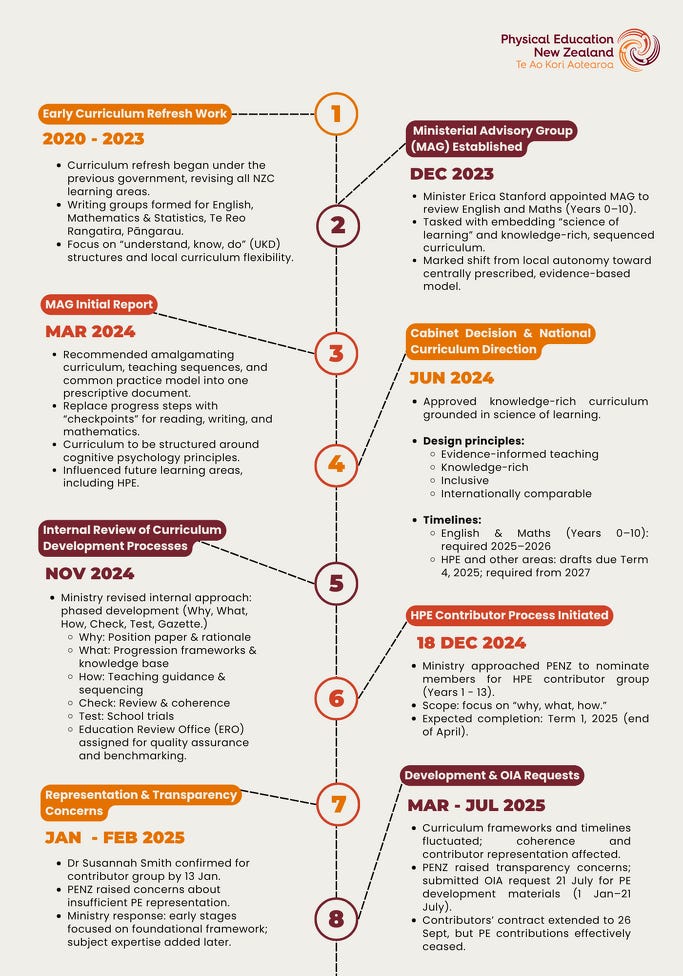
2020–2023: Early Curriculum Refresh Work
The curriculum refresh process began under the previous government, aiming to revise all learning areas of The New Zealand Curriculum (NZC).
Writing groups were established for early learning area development (English, Mathematics & Statistics, Te Reo Rangatira, Pāngarau).
The approach emphasised “understand, know, do” (UKD) structures and local curriculum flexibility.
December 2023: Establishment of the Ministerial Advisory Group (MAG)
Minister Erica Stanford appointed a Ministerial Advisory Group (MAG) to review English and Mathematics & Statistics for Years 0–10, and to advise on the Common Practice Model and teaching sequences.
The MAG was tasked with embedding the “science of learning” and creating knowledge-rich, well-sequenced curriculum documents.
This marked a philosophical shift away from local autonomy toward a centrally prescribed, evidence-based model.
March 2024: MAG Initial Report
The MAG delivered its initial report recommending:
The amalgamation of curriculum, teaching sequences, and the common practice model into one prescriptive document.
Replacement of progress steps with “checkpoints” for reading, writing, and mathematics.
Curriculum to be structured around cognitive psychology (“science of learning”) principles.
These recommendations directly influenced the design and sequencing of future learning areas, including HPE.
June 2024: Cabinet Decision and National Curriculum Direction
Cabinet approved the new national direction, a knowledge-rich curriculum grounded in the science of learning. The design principles were confirmed:
Underpinned by the science of learning
Knowledge-rich
Inclusive of evidence-informed teaching practices
Clear and easy to use
Internationally comparable
Supportive of key competencies and Māori-medium contexts
Cabinet timelines included:
English & Maths (Years 0–10): required by 2025–2026
HPE and remaining learning areas: drafts due Term 4, 2025, required from 2027.
November 2024: Internal Review of Curriculum Development Processes
From communications with the Ministry, they reported that following lessons from English and Maths development, they revised its internal approach to improve representation and alignment. Each learning area would now be developed through phased stages: “Why, What, How, Check, Test, Gazette.”
Why: Position paper and rationale
What: Progression frameworks and knowledge base
How: Teaching guidance and sequencing
Check: Review and coherence across learning areas
Testing: School trials before gazetting
The Education Review Office (ERO) was assigned to provide quality assurance and international benchmarking.
18 December 2024: HPE Contributor Process Initiated
The Ministry of Education approached PENZ to nominate members for the HPE contributor group.
Contributor group structure and framework was established.
Scope for contributors was for Year 1-13.
Our role was to focus on the “why”, “what”, “how” (see above).
The Ministry indicated that the HPE would be expected to be completed in Term 1, 2025 (or at the end of April).
January–February 2025: Representation and Transparency Concerns
By 13 January, PENZ had confirmed, per the ministry timeline, Dr. Susannah Smith’s involvement as a ‘contributor’.
Names of the contributors would be published on 10 February by the Ministry.
PENZ raised concerns with the Ministry about insufficient PE representation on the HPE contributors’ group, noting that Outdoor Education and Health each had two representatives while Physical Education had only one .
The Ministry responded that early stages focused on establishing a “broad foundational framework” before adding subject-specific expertise later in the process, and that group composition would evolve as work progressed.
March – July 2025: Continued Development and OIA Requests
By April, the coherence group had begun to review curriculum documentation and the timeline for curriculum development was extended until the end of June. Our understanding is that curriculum frameworks continued to change which caused a delay in the development process.
During this timeframe, it is unclear if consistent representation and contribution were possible given the fluctuating timelines.
PENZ continued to express concerns about transparency and sector representation.
In good faith, concerns were raised within the appropriate forums and inline with all non-disclosure agreements.
On 21 July 2025, PENZ formally submitted an Official Information Act request seeking all materials and communications relating to the PE component of HPE development from 1 January – 21 July 2025
At the end of July, the Ministry applied an additional contract extension to the Contributors. This would take their involvement through until 26 September 2025. Although contributors were available, contributions for Physical Education had effectively ceased in July.
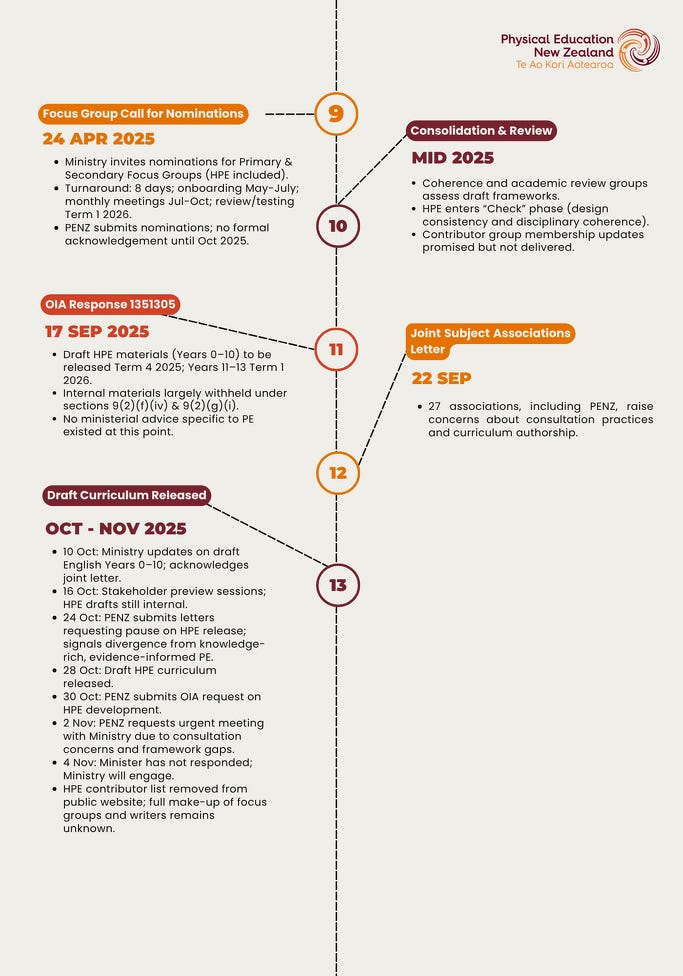
24 Apr 2025 — Focus Group Call for Nominations
A Ministry email to associations “Helping us to update The New Curriculum: Focus Group” invites nominations for Primary and Secondary Focus Groups across learning areas, incl. HPE.
Nominations due 2 May 2025, an 8 day turnaround; onboarding sessions May–July 2025; monthly meetings Jul–Oct 2025; review/testing Term 1 2026.
PENZ submits nominations, but no formal acknowledgement follows until Oct 2025, when the Ministry is questioned on this.
Mid 2025: Consolidation and Review Phases
The coherence group and academic review groups began reviewing draft frameworks across learning areas.
The HPE curriculum entered its “Check” phase, focusing on design consistency and disciplinary coherence with other learning areas.
The Ministry reiterated that the HPE contributor group’s membership would be periodically updated based on expertise required at each phase. In effect, no substantive updates were provided from the end of July.
17 September 2025: OIA Response 1351305
The Ministry confirmed:
Draft HPE materials (Years 0-10) would be released early Term 4 2025, with Years 11-13 to follow in Term 1 2026.
In-class testing of Years 0-10 material would occur in Term 1 2026, followed by sector feedback on Years 0-13 content.
Fourteen internal emails, eleven attachments (curriculum iterations, international analysis, contributor guidelines, and expert discussions) were identified but withheld under sections 9(2)(f)(iv) and 9(2)(g)(i) of the Act.
No ministerial advice or decisions specific to the PE component existed yet; therefore, those parts were refused under s18(e) – information not yet created.
The Ministry reiterated that the draft would soon be released and further OIA requests could be reconsidered after publication.
22 Sep 2025 — Joint Subject Associations’ letter (sent to Ministry)
27 subject associations, including PENZ, send a joint letter to the Minister raising concerns about consultation practices, who is writing Phase 5 and VET subjects, and NEX funding and roles. 
October-November 2025: Draft Curriculum Released
10 October 2025
The Ministry circulated updates on the availability of draft English Years 0-10 materials, noting a cross-curricular coherence review across all learning areas.
The Ministry also responded to Joint Subject Associations letter acknowledging varied engagement experiences, commits to including subject associations in Years 11–13 development and to seek nominations. It is our understanding that, to date, no subject associations have been included in the Years 11-13 development.
16 October 2025
Stakeholders were invited to preview sessions; the HPE drafts were still under internal review and not released publicly at this stage.
These preview sessions were held online, and the curriculum was shared in a “scroll through” on screen.
24 October 2025
PENZ letters signalling escalating concerns:
Open Letter to the Minister requesting a pause on the HPE release and a meeting to address divergence from a knowledge-rich, evidence-informed PE (e.g., performative movement emphasis; separation/omission of sociocultural knowledge). 
Email to the Ministry forwarding “Concerns About Curriculum Process,” signalling significant concerns with the direction of travel for HPE. 
28 October 2025
The draft HPE curriculum was released.
30 October 2025
PENZ submits another OIA request about the development of the HPE curriculum. The request has been acknowledged by the Ministry.
2 November 2025
PENZ submits another formal request for an urgent meeting with the Ministry, citing loss of confidence in the consultation process, risks to inclusion and equity, and the need for a coherent framework connecting health, PE, and outdoor education; while acknowledging positives (motor skills, movement concepts, OED recognition). 
As of 4 November 2025
The Minister has not responded to our request for a meeting.
The Ministry has responded to our request for a meeting and we will work with them on this.
The list of HPE contributors has been removed from the Ministry’s Tāhurangi website, further reducing public visibility of those initially involved in curriculum development.
In our view, this removal coincides with rising concerns from subject associations (including PENZ) about lack of transparency and consultation in the HPE development process.
To date the full make up of the focus groups and the writers of the curriculum remain a mystery.
Written with the careful, attentive levelheadedness that marks the scholarship of our profession. It is this thoroughness that is the counter to poor processes.
Thank you Heemi.
Thank you for continuing to outline what is happening. Do you know the rationale for the NDAs? I know that people had to sign NDAs in all the subject areas and I am at a loss to understand why NDAs would be required for people writing the national curriculum. Why would it not be completely transparent? What would need to remain confidential? Has that been standard in the past?