


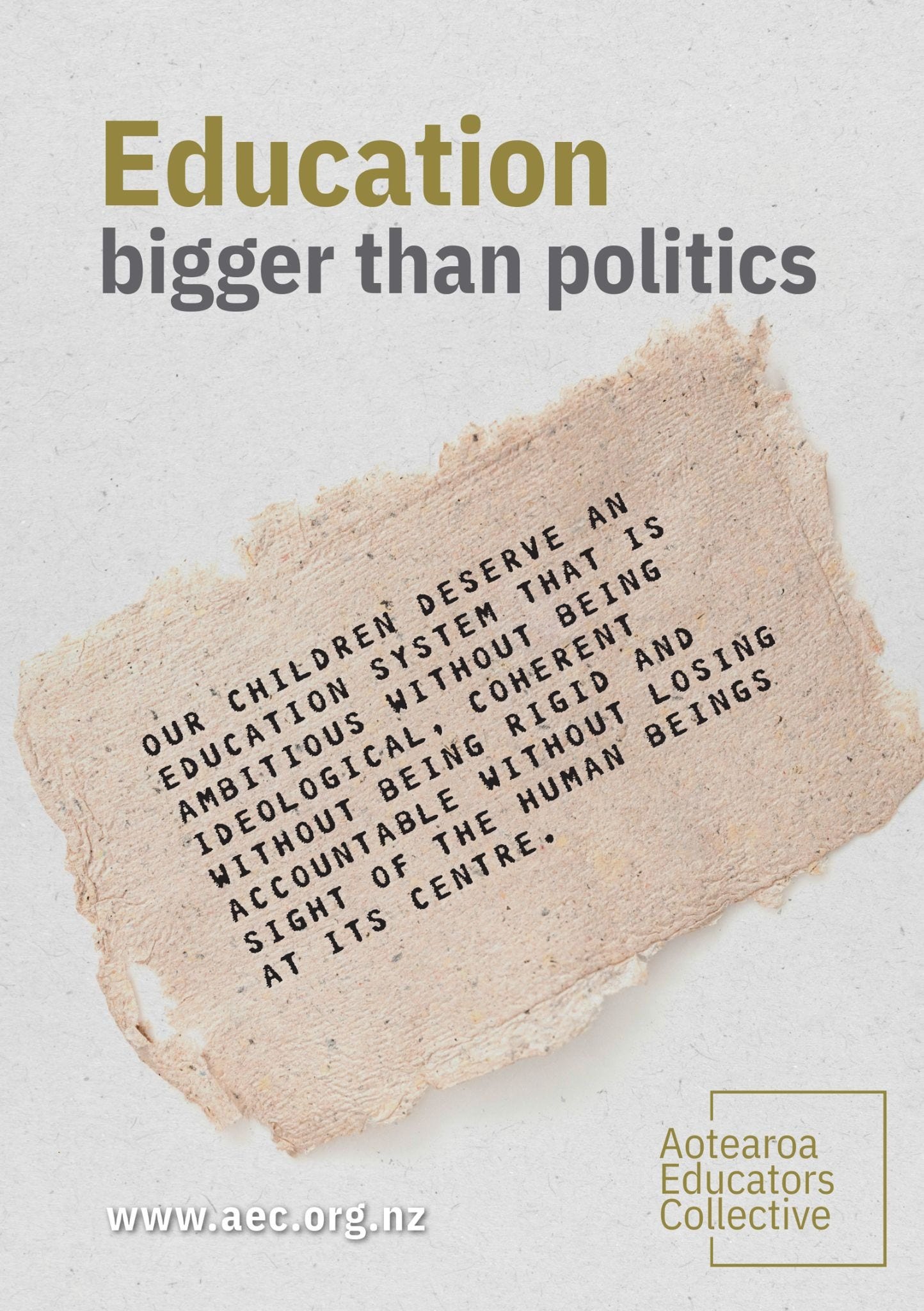
Our children deserve an education system that is ambitious without being ideological, coherent without being rigid, and accountable without losing sight of the human beings at its centre.
For too long, education policy in Aotearoa has swung between competing extremes. Educators hold on for dear life as we swing between more freedom then more prescription, knowledge vs skills, excellence vs equity, and national consistency vs local responsiveness. We don’t believe these are either/or choices - these should be the aspiration for the type of education system our tamariki disservice.
This is why we are excited to be launching our election platform - Education: Bigger than politics.
Following the release of the Aotearoa Educators Collective Vision Document, we have launched our election platform summary. We’ve been intentionally selective - rather than creating an exhaustive list of policies, we are focusing on a small, vital set of ideas aligned directly against our five core aspirations for transformative change in education.
The Aotearoa Educators’ Collective is asking all political parties to commit to a measured middle ground: strong foundations and broad opportunities, clear national expectations and local responsiveness, professional trust and accountability, academic success and preparation for life.
1. Re-establish a bicultural curriculum - An education grounded in Aotearoa.
Why Aotearoa Should Care: Every child should understand the country they live in, its histories, cultures, and relationships. Te reo Māori, tikanga Māori, and mātauranga Māori give all learners access to knowledge that is distinctive to Aotearoa while enabling Māori learners to see their identity, language, and culture genuinely reflected in their education. A bicultural curriculum strengthens belonging, critical thinking, and social cohesion.
What Government Could Do: Restore clear Te Tiriti commitments across education legislation, curriculum, and governance. Restore 2023 Te Mātaiaho as the foundation of the New Zealand Curriculum. Fund genuine partnerships with mana whenua alongside sustained teacher learning so local histories, te reo, tikanga, and mātauranga Māori are embedded meaningfully rather than added superficially.
AEC Calls For: Restoring Māori knowledge alongside disciplinary and global knowledge, not one replacing the other.
2. Increase equity of outcomes - High expectations. Different support when it is needed.
Why Aotearoa Should Care: A child’s postcode, household income, ethnicity, disability, or learning needs should not determine how far they can go. Equity does not mean lowering expectations or giving everybody exactly the same thing - it means maintaining high expectations while making sure every learner has a genuine opportunity to reach them. Persistent differences in outcomes require system responses rather than simply blaming individual children, families, or teachers.
What Government Could Do: Create a National Learning Support Guarantee so families know what support their child can expect wherever they live, backed by sufficient specialist staffing and funding weighted towards need. Introduce an Equity Impact Test for major reforms, requiring curriculum and assessment changes to be piloted and their likely impact on Māori, Pacific, disabled, neurodivergent, rural, and economically disadvantaged learners made public. Invest in Ka Hikitia – Ka Hāpaitia | The Māori Education Strategy and the Action Plan for Pacific Education.
AEC Calls For: Individualised support that truly matches every child’s needs, rather than one-size-fits-all provision.
3. Broaden the curriculum - Prepare young people for success, work, citizenship, and life.
Why Aotearoa Should Care: Literacy, numeracy, and disciplinary knowledge matter enormously. But our children will enter a world shaped by AI, technological disruption, environmental challenges, and changing workplaces. They will also need judgement, creativity, collaboration, adaptability, ethics, wellbeing, and the ability to turn knowledge into action. The OECD describes this broader purpose as education for human flourishing.
What Government Could Do: Guarantee every learner a broad curriculum that strengthens literacy and numeracy while protecting science, humanities, arts, technologies, health, physical education, and vocational learning. Strengthen rather than simply replace our senior qualification system, combining clearer national expectations and stronger moderation with multiple credible ways of demonstrating learning (examinations, practical work, portfolios, projects, and workplace/community learning). Protect space for exploration and pursuing passions, respecting the value of developing the whole person.
AEC Calls For: A balance of knowledge and capabilities, depth and breadth, academic and vocational success.
4. Re-professionalise teachers - Trust and support great teachers to teach.
Why Aotearoa Should Care: Parents rightly expect teachers to be knowledgeable, skilled, and accountable. But teaching is complex work. The best teacher for your child needs enough professional expertise and judgement to respond to the learners actually sitting in front of them. Excessive autonomy can create inconsistency, while excessive prescription turns teaching into content coverage and constrains responsiveness. Professional trust supports collaboration, teacher wellbeing, and sustained improvement.
What Government Could Do: Restore genuinely profession-led teacher regulation, including meaningful elected teacher representation and professional independence in setting teaching standards and the professional code. Set clear national learning expectations while protecting professional judgement about how they are taught, backed by high-quality resources, sustained professional learning, and time for teachers to collaborate. Provide centrally funded paraprofessional (including teacher aide) career pathways.
AEC Calls For: Keeping checks and balances, but respecting and empowering teachers’ professionalism and skill.
5. Build a shared understanding of education - Stop rebuilding the system every election.
Why Aotearoa Should Care: The purpose of education must go beyond test scores and attendance. Education influences opportunity, employment, wellbeing, citizenship, identity, social cohesion, and ultimately the kind of country we become. Parents and teachers need stability - constant reform consumes money and energy that could be spent improving learning. Education is a human right, a public good, and a shared responsibility.
What Government Could Do: Establish an independent statutory Curriculum, Assessment and Pedagogy Council, with genuine Māori partnership and representation from Pacific communities, educators, researchers, parents, learners, and communities. Give it responsibility for long-term curriculum and assessment stewardship through a transparent improvement cycle rather than repeated political resets. Develop a cross-party National Education Accord defining what education is for and the outcomes we collectively value.
AEC Calls For: Stability without stagnation and improvement without upheaval.
Help Us Put Education Above Politics
Real change happens when politicians hear directly from educators, parents, and communities who care about the future of learning in Aotearoa.
We need your voice to amplify these commitments:
Share them on social media (Facebook, Instagram,
Tag local MPs, Education Spokespeople, and Candidates across all political parties in your posts to ask if they will commit to these five aspirations.
Let’s ensure education policy is built for long-term flourishing - not the next election cycle.
You can read more about the Aotearoa Educators Collective Vision for Education in Aotearoa at aec.org.nz/publications.
Dear AECNZ,
Thank you for the work you are doing to strengthen education in Aotearoa.
I would like to raise two closely connected issues that I believe deserve serious consideration: how we prepare people for parenthood, and how we prepare people for Parliament.
We require education, training and demonstrated competence for many responsibilities because we recognise that ignorance can harm others. Yet two roles with extraordinarily long-lasting consequences—the raising of children and the exercise of legislative power—receive remarkably little comparable preparation.
This raises a simple but uncomfortable question:
Why have we become comfortable requiring preparation for many forms of work, while treating preparation for raising human beings and governing a country largely as a matter of personal choice?
The issue is deeper than whether individual parents or parliamentarians are “good” or “bad”. It concerns assumptions we have inherited about parental authority, family privacy and democratic legitimacy.
Family privacy matters. So does parental autonomy. But these principles should not mean that preparation for parenthood is unnecessary. A child is not the property of a parent. A child is a dependent human being whose safety, development and dignity can be profoundly affected by decisions made inside the family. Research on early childhood development, parenting interventions and family engagement consistently demonstrates the importance of the environments adults create around children.
The same distinction applies to Parliament. Being elected provides democratic legitimacy; it does not automatically provide knowledge of legislation, public finance, constitutional arrangements, government machinery, economics or evidence-based policy. Parliamentary research has long examined professional development, induction and capacity-building for elected representatives.
This leads to a broader principle:
Authority should create a stronger expectation of preparation, not eliminate it.
For parents, serious education could include child development, safeguarding, health, emotional regulation, communication, education and the responsibilities attached to parental authority.
For parliamentarians, it could include New Zealand's constitutional system, legislation, public finance, government machinery, evidence evaluation, policy analysis, economics, ethics and parliamentary procedure.
The purpose would not be to standardise families or turn politicians into technocrats. It would be to give people greater knowledge before they exercise responsibilities whose consequences can extend far beyond themselves.
There is also an important democratic dimension. A parliamentarian who lacks sufficient knowledge may become more dependent on whoever has the knowledge needed to interpret legislation, evidence, finance or government processes. Education cannot guarantee independent judgement. But knowledge gives people a greater capacity to question, scrutinise and make their own judgements.
Perhaps the deeper question is therefore this:
If we take children, democracy and the future of Aotearoa seriously, why should the people entrusted with them not be expected to prepare seriously for that responsibility?
I am therefore asking AECNZ to consider whether this is a conversation you could help bring into the public and educational sphere: whether New Zealand should establish serious, structured preparation for parenthood and compulsory education for parliamentarians. I am approaching AECNZ because, as educators and advocates for the role of education in society, you are uniquely positioned to question where education is missing from responsibilities that profoundly shape our children, our institutions and our future.
If you believe this question deserves consideration, I would welcome AECNZ's response, discussion, or support in bringing it into a wider national conversation.
Kind regards,
Saad Abou-Chakra
pansophics.substack.com
Couldn’t agree with you more. Well stated. I’m passing this on to my local MP.