

Standardisation is not the same thing as high standards
And equality of opportunity will not achieve equitable outcomes



On Thursday, I had the opportunity to attend the Auckland edition of the Ministry of Education Curriculum and Assessment Roadshow for leaders.
It was an interesting day, to say the least.
Actually, is interesting the right word? If I am honest, it was more frustrating than interesting.
We were corralled into the Ellerslie Racecourse Convention Centre and spent the day listening to a combination of guest speakers, Ministry staff and principals involved in the current change and reform programme. I am guessing the intention was to ensure school leaders were across the changes, reassured by the process and ready to move forward with the implementation timeline: the Foundational Award in Year 11 in 2028, the new NZCE in 2029 and the NZACE in 2030.
The problem was that it became patently clear, very early on, that we were not going to learn much that was new.
Instead, we were being presented with a mixture of messaging, reassurance and spin, all carefully designed to tell us that these reforms are carefully thought through, broadly supported and on track.
What actually happened, for me at least, was that the day highlighted two things.
The first is that, across much of the coalition’s current education agenda, standardisation is being mistaken for high standards.
The second is that the reforms appear to be built on a very thin understanding of equity.
There is a fundamental flaw sitting underneath all of this. It is the belief that, in order for everyone to succeed, everyone needs to receive the same teaching, the same learning and the same assessment. This is why we are seeing an increasing push towards prescribed, standardised and inflexible curriculum subjects and assessment pathways.
At this point I want to ensure everyone is aware of the recent review of the UK education reforms. These are the very reforms that seem to have influenced the current changes to our curriculum design and increasing focus on assessment. Remember Nick Gibb, UK Minister of State for Schools, the man behind the very reforms that this review comments on was the guest of honour at earlier curriculum roadshows. Our Minister has even gone as far as acknowledging him as something of a mentor.
Keep all of this in mind when you read the following.
The current system is not working well for all
The socio-economic gap in relation to educational attainment remains stubbornly wide, and young people with special educational needs and disabilities (SEND) make less progress than their peers. Whilst the explanations for this often lie outside the curriculum and assessment, the Review has worked to ensure that the system reflects high expectations for all and properly supports all young people’s progress and achievement.
Our recommendations aim to improve curriculum quality for all young people but will particularly benefit those for whom the system is currently not working well. We have also made recommendations to support better equity, access and inclusivity in subject areas where we have identified specific barriers to progress. In addition, we have sought to ensure that the curriculum and assessment are helpful to teachers in supporting progress, momentum and successful outcomes as learners move from one key stage to the next.
We also highlight the roles other government agencies and bodies can play in exemplifying how to meet diverse needs in an inclusive mainstream school and in supporting good practice.
This becomes particularly problematic in the senior school when it becomes tangled up in high stakes assessment. It would seem that the increased standardisation and narrowing of the curriculum and subjects also seems to have impacted outcomes in the UK.
Curriculum shape and challenges with specific subjects
Specific problems with content in some curriculum areas impede the quality of teaching and learning, as well as pupil outcomes. There are tensions with curriculum breadth and depth and, consequently, these present a challenge for schools and colleges in meeting the important local needs and enrichment provision which are highly valued by young people and their parents and carers.
The statutory guidance for the current national curriculum says that it is ‘just one element in the education of every child’;2 it was not intended to take up an entire school day. It is important that the national curriculum maintains its position as an ambitious entitlement for all. However, schools must have space to go beyond it to provide innovative practice, locally tailored content, and enrichment activities that help to ensure young people thrive in education and later life.
Evidence supports the need to build secure foundations and mastery of key subject concepts to raise standards and enable the development of expertise. But, in some subjects, the current construction and balance of content appear to be inhibiting this. This may impede mastery and prevent young people developing an appropriate depth of understanding, hindering their progress and undermining standards.
I mean if we are going to look to the UK for our reforms, let’s at least also learn from their lessons about what did and didn’t work.
You can read the full review here:

Do not get me wrong. I absolutely understand the need for a solid foundation. Every young person needs to be supported to develop excellent literacy and numeracy skills. I would add digital literacy to that as well. Of course we want a young population who are literate, numerate and able to navigate the world in front of them.
See once again, the findings from the UK reform review.
The curriculum needs to respond to social and technological change
In a world of rapid technological, environmental and social change, subject-specific knowledge remains the best investment. Being secure in core subjects such as Maths and Science will remain pivotal for young people, now and in the future, as will their understanding of human culture through the humanities, languages, and arts. However, additional knowledge and skills will be needed if we are to maximise young people’s opportunities and equip them to meet challenges presented by our fast-changing world. The rise of artificial intelligence (AI) and trends in digital information demand heightened media literacy and critical thinking, as well as digital skills. Likewise, global challenges, both social and environmental, require attention to scientific and cultural knowledge and skills.
What we do not need is a whole generation of young people learning exactly the same thing, in exactly the same way, at exactly the same time.
In fact, we are kidding ourselves if we think any two students, even in the most prescribed subject or syllabus, ever come out having learnt exactly the same thing. Unless two students take the same five subjects for three years, are taught by the same teachers, in the same context, with the same life experiences, needs, interests and supports, what they actually learn will differ.
And that is not a problem. That is education. Meeting differing needs in different ways, should be the whole point of school and part of any and every educational journey. We have a mantra at Albany Senior High School - it is not if you’re bright, it is how you are bright! I think the reason Foundation Principal, Barbara Cavanagh loved this quote (and why it remains central to everything we do) is because every young person is different and we actually believe that is a strength and not something we need iron out of them!
This idea that, in order for a subject or learning to be legitimate, we have to teach the whole subject, assess the whole subject, package the whole subject and deliver it all in the same way is nonsense.
It is also not supported by what we know about upper secondary certification internationally. The OECD’s recent work on upper secondary certification shows that strong systems do not need to choose between local professional judgement and external credibility. In fact, across the certificates the OECD analysed, most included at least one component set or assessed by schools and at least one component set or assessed externally. In other words, high trust and external rigour can coexist. Flexible, school-based assessment is not some strange New Zealand weakness. It is part of how many credible senior secondary systems actually work.
You can check out that full report here:
What we should be designing is a qualification system that has clear expectations, strong quality assurance and enough flexibility for schools to design meaningful learning in response to their students and communities.
That is not “gaming the system”, I am pretty sure that is called curriculum design.
This lazy language about schools “gaming” NCEA drives me a little bit nuts. Yes, there have been issues with over-assessment. Yes, cherry-picking random standards without coherence does not make much sense. Yes, we should be able to strengthen the system.
But flexible, personalised and contextualised pathways are not automatically evidence of bad practice. In many cases, they are evidence of excellent practice.
Across Aotearoa, there are incredible examples of courses that have been designed over time to meet the needs of specific communities. Courses that connect with local industries, local iwi, local environments, local histories and local futures. Courses that help young people see themselves in their learning. Courses that keep students engaged long enough to succeed.
That is not a loophole, that is the point of effective teaching and learning.
Why now, do we seem to be increasingly uncomfortable with diverse definitions of success?
Every young person we have in front of us is different. They have different interests, different strengths, different needs and different ways of demonstrating what they know and can do. To force each of them into the same mould is a waste of everyone’s time.
It also completely misses the difference between equality and equity.
A recent RNZ piece picked up this wider concern about the current government’s apparent preference for equality over equity. That distinction matters. Equality says everyone gets the same thing. Equity asks what each person needs in order to succeed.
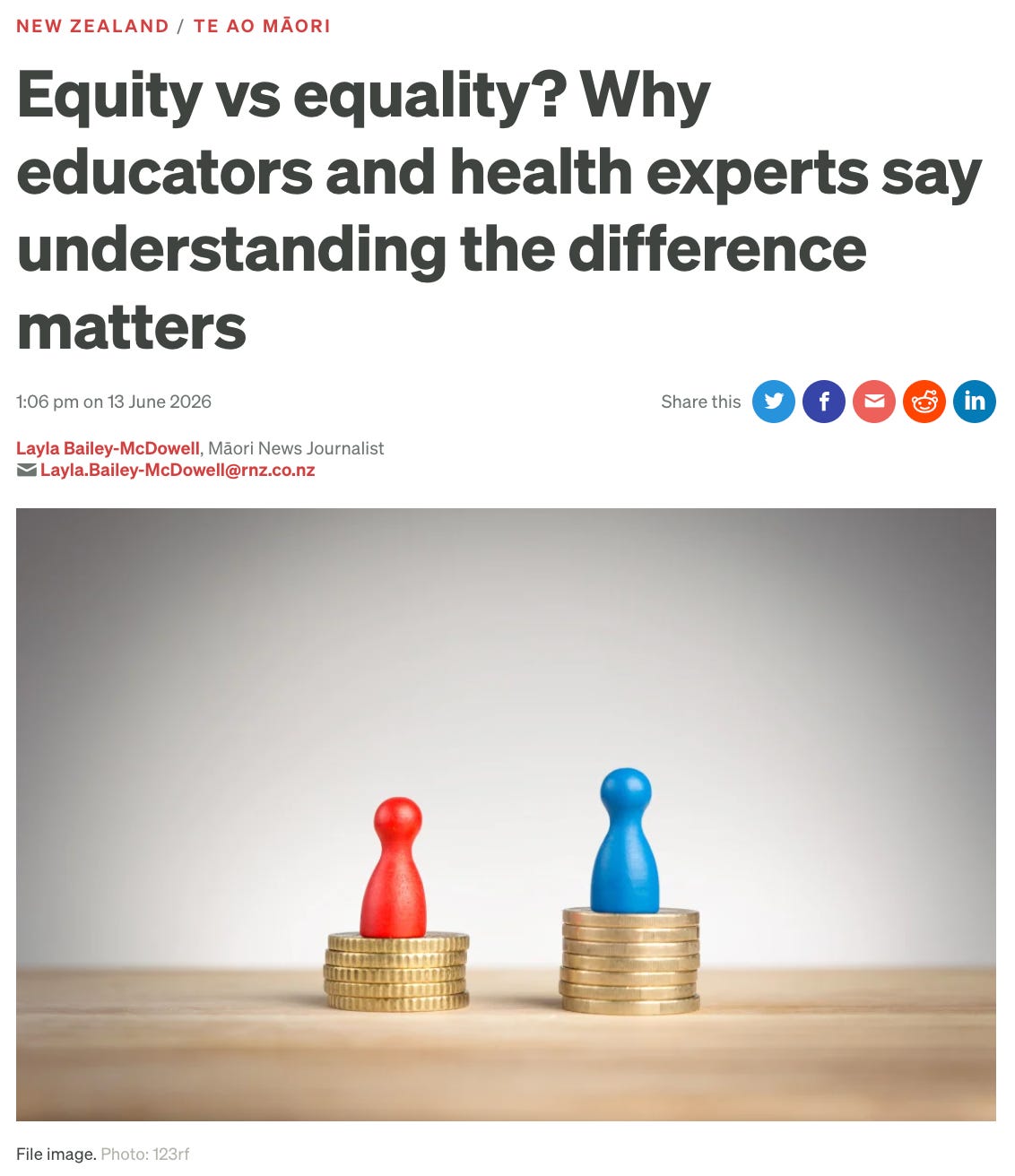
Anyone who has spent more than five minutes in a classroom knows that sameness is not fairness.
If we are genuinely serious about improving outcomes across the board, and especially for those young people who have been least well served by the system, then we should be very comfortable with students having different experiences of teaching, learning and assessment during their senior secondary years.
That is not about lowering expectations, this is how you meet students where they are and support them to move forward.
I do think there is a sensible middle ground.
All young people should leave school literate, numerate and digitally capable. I would be very happy to see Year 11 focused on a strong foundation certificate that supports and assesses those skills well. I would also like to see literacy and numeracy support continue into Year 12, particularly for students who need it, and for those heading towards university pathways where further literacy and numeracy demands are high.
Beyond that, I think we should be opening up more freedom, not less.
There is an opportunity to design a system where schools develop coherent Level 2 and Level 3 courses that are checked, verified and quality assured before becoming recognised assessment pathways for NZCE and NZACE. That would allow us to ensure rigour without giving away ‘local curriculum’. It would allow us to keep pathways clear without pretending all students need the same pathway.
We know that the push for “whole subjects” is often really about making sure young people have bundles of learning that prepare them for specific destinations. That makes sense for some students. If a young person is heading into engineering, medicine, architecture, science or a specific university pathway, then yes, they may need a full Level 3 mathematics and statistics course, or physics, or chemistry, or geography, or whatever that pathway requires.
That can still happen.
University Entrance can still (and I am sure will) set requirements. Tertiary providers can still identify the preparation students need. Schools can still offer traditional disciplinary courses for students who need or want them.
But the vast majority of young people do not head straight to university. They head into a complex world where the ability to learn, adapt, collaborate, communicate, problem-solve and stay engaged matters enormously.
For those young people, the question is not simply, “Did you complete the whole subject?”
The better question is, “Did this learning help you build knowledge, capability, confidence and direction?”
This brings me back to the roadshow and one of the more interesting moments of the day.
In the afternoon, we heard from Leah Gates from the Auckland Business Chamber. Her presentation, FutureFit: Aligning Education with a Changing Economy, was probably the part of the day I found most interesting. She was able to talk about the bigger picture: industry, the world of work and the skills and competencies young people need to demonstrate in order to thrive.
She may not have intended to make this point, but what she actually highlighted was that the current package of reforms is not actually aligned with what our young people need.
She talked about the importance of competencies, adaptability and skills for a changing economy. And we know these things are not best developed through rigid, siloed, one-size-fits-all courses. They are best developed through meaningful contexts. Through learning that students can connect with. Through projects, problems, disciplines, communities and pathways that actually matter to them.
This is also why I am deeply concerned about the emerging binary between “academic” and “vocational” subjects.
I understand why we would work with industry skills boards to design packages of learning informed by what workplaces need. In the same way, I understand why we would work with universities to understand what academic preparation is needed for particular tertiary pathways.
What I do not understand is the desire to bundle young people into academic silos over here and vocational silos over there, as though the real world operates like a 1970s careers pamphlet.
It does not.
The real world is much more complex than that. Most meaningful work requires a blend of conceptual knowledge, practical skill, communication, judgement, creativity, discipline and adaptability. Academic and vocational learning are not opposites. They are deeply connected.
A good education system should understand that.
So, in closing, there are plenty of problems with the current direction of travel. But the one I keep coming back to is this: we are deluded if we think outcomes will improve simply because everything is more standardised, more locked down and more prescribed.
High standards do not require sameness.
Rigour does not require rigidity.
Credibility does not require the death of local curriculum.
If we force young people into narrow, round holes, we should not be surprised when the square pegs become frustrated, disconnected or disengaged. If their learning and assessment no longer reflect their interests, passions, needs, strengths and contexts, many will simply fall away.
And then we will call that failure theirs, rather than ours.
I implore those involved in these reforms to reconsider this obsession with uniformity. Reconsider the assumption that prescribed courses and standardised pathways will somehow close the divide. Reconsider the idea that flexibility is the enemy of quality.
The world is complex.
Our young people are complex.
If we genuinely want to improve outcomes, we need to resource schools to respond to that complexity. We need to support different students differently. We need to trust teachers and leaders to design learning that is coherent, contextualised and rigorous.
Because if we simply offer the same old thing, only more standardised, we will not close the divide.
We will make it worse.
And we will lose young people along the way.
Interesting that the UK review that you shared in this article, notes (p163) one recommendation that their new qualification for 16-19 year olds are, "Assessed in a modular way to allow learners to build up and ‘bank’ their progress, giving accreditation for modules learners have passed." - now, what does that sound like?
...and on page 169, some wisdom that could have made reform more manageable in NZ by staging it per decade and "The Government should also ensure that future reviews strike an appropriate balance between external expert input and central coordination and that it evaluates the likely impact of any proposed changes, including considering the capacity and workload of professionals and educational institutions."