

Proposal to replace NCEA confirmed
And yet another reform we didn’t ask for and don’t need.

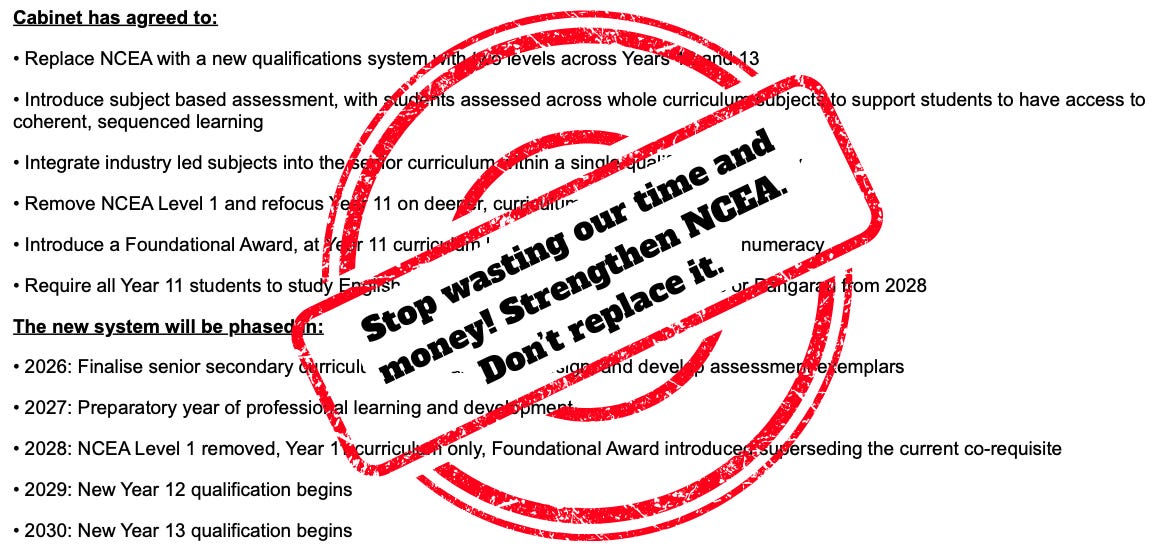
There’s a familiar rhythm to education reform in Aotearoa.
A problem is identified.
The problem is then framed as a crisis.
Hyperbolic claims made about the demise of our education system.
Confidence dips.
Headlines follow.
Finally, almost inevitably, we reach for the biggest, most visible lever available: replace the system.
So here we are again. The proposal to replace NCEA has now been confirmed, framed as the solution to concerns about credibility, coherence, and public trust. On the surface, it sounds decisive. Even reassuring.
But if you look more closely (at the evidence, at the history, and at what is actually being proposed) it becomes clear that this is not the reform we need. It’s not even the reform the evidence supports. It’s a costly, disruptive reset that risks solving the wrong problem while creating several new ones.
Let’s be clear about something upfront. The issues being raised about NCEA are not invented. They are real, and many of us working in schools see them every day. The flexibility of the system has, in some cases, tipped into fragmentation. Students can “credit shop.” Courses can lack coherence. And because it is technically possible to gain qualifications entirely through internal assessment, there are legitimate concerns about consistency and comparability across schools.
The OECD names this directly, in a recent report about senior secondary qualifications from around the globe, even using New Zealand as an example of a system where internal-only pathways are possible and where that can create challenges for reliability .
So yes, to a degree, the diagnosis holds.
But here’s the part that gets lost in the current narrative: the OECD does not conclude that systems like this should be replaced. In fact, it says almost the opposite.
What the OECD is remarkably consistent about is this: high-performing, durable qualification systems don’t swing between extremes. They don’t overcorrect. They balance. They work because they hold together four things at once - relevance, credibility, fairness, and manageability, and they begin to fail when they become unbalanced .
And that’s exactly where this proposal goes wrong.
Because what’s being presented as a case for replacement is, in reality, a case for recalibration.
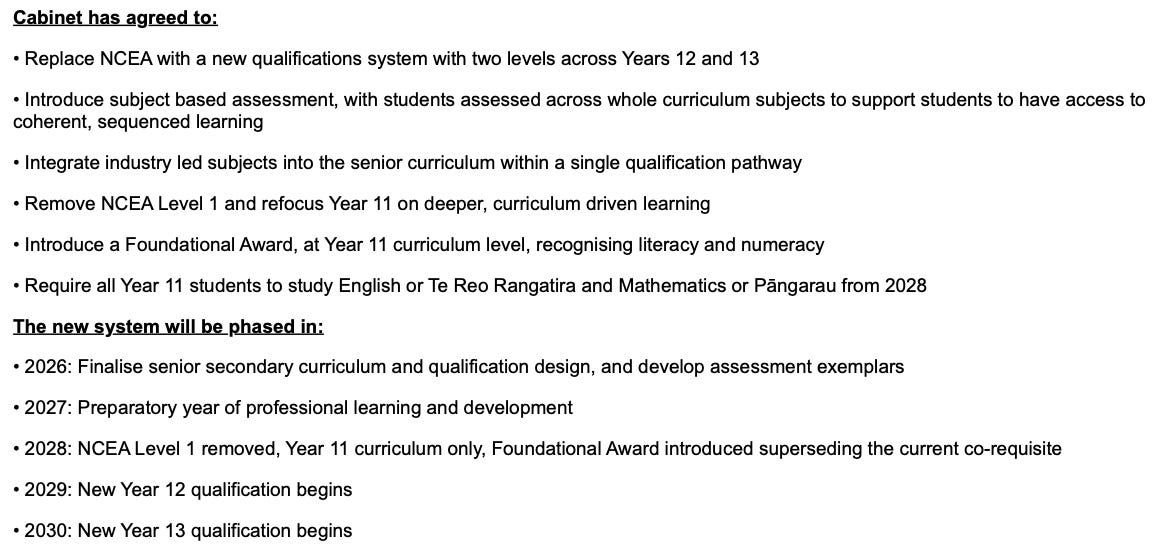
Many of the actual changes being proposed (more defined subject structures, clearer expectations at each level, reducing the “anything goes” nature of credit accumulation) are entirely sensible. They are, in fact, aligned with what the OECD suggests improves the strength of a qualification.
A warning though. The statement “Introduce subject based assessment, with students assessed across whole curriculum subjects to support students to have access to coherent, sequenced learning” should be a warning shot as to what we will be facing with our new Phase 5 curricular. This statement suggests we are moving away from “curriculum” and suggests that a “prescribed syllabus” is waiting in the wings.
The absence of any detail about the format of assessment should also make us nervous. Announcements that are “vague by design” are often designed to reassure. The pain points glossed over or avoided altogether.
Another potential red flag is the plan “to integrate industry led subjects into the senior curriculum within a single qualification pathway” - will this see the (re)introduction of a two tier pathway that we thankfully left behind last century. Trade Colleges, anyone?
Also the plan to “remove NCEA Level 1 and refocus Year 11 on deeper, curriculum driven learning” and “Introduce a Foundational Award, at Year 11 curriculum level, recognising literacy and numeracy” will be deeply problematic for some communities.
These are not tweaks. These are all significant reforms that will most likely impact our most “at-risk” rangatahi.
And also, none of these changes require a wholesale replacement of NCEA.
They require us to tighten the rules of the game, not throw out the game entirely.
This is where the reform starts to feel less like evidence-informed improvement and more like political theatre. Because replacing a qualification has symbolic power. It signals action. It suggests a fresh start. But it is also extraordinarily expensive, time-consuming, and disruptive - not just in terms of dollars, but in terms of teacher capacity, system stability, and student experience.
And critically, it diverts attention from the work that actually needs to be done.
If the issue is coherence, then we should be designing courses that require meaningful engagement with a body of learning, ensuring students can’t simply assemble a qualification through disconnected standards.
If the issue is credibility, then we should be strengthening a balanced model of assessment, one that combines external anchors for comparability with rich internal assessments that capture the complexity of real learning. The OECD is clear that systems relying solely on one mode (particularly internal-only) struggle to hold trust, but it is equally clear that over-reliance on exams reduces validity and relevance .
If the issue is public understanding, then we should be fixing how we report and communicate achievement, because qualifications are as much about signalling as they are about assessing.
And if the real issue is equity and inclusion (and it always should be) then we need to be very cautious about large-scale system change. The Ministry itself acknowledges that major reforms tend to produce short-term dips in achievement, and those dips are not evenly distributed. They land hardest on the very students we most need to support .
That risk is not incidental. It is predictable.
Which raises the obvious question: why are we choosing the most disruptive lever available, when the evidence points to more targeted, less risky solutions?
There’s also something deeper at play here. NCEA, for all its flaws, was designed to broaden what counts as success. It made space for different ways of demonstrating learning. It allowed for more authentic, applied, and context-rich assessment. It created pathways for students who had historically been underserved by more traditional, exam-dominated systems.
That breadth matters. And while it absolutely needs refinement, we should be very wary of reforms that narrow the definition of achievement in the name of credibility.
Because credibility that comes at the expense of relevance is not credibility at all - it’s compliance. It is about control.
And systems built on compliance and control rarely endure.
What’s frustrating about this moment is that we are not short on evidence. We are not short on expertise. Across the sector, there is a clear understanding of what needs to be strengthened and how.
What we are short on is the willingness to do the less visible, more complex work of improvement.
It is much easier to replace than it is to refine. Much easier to rebrand than to recalibrate. Much easier to announce a new system than to patiently strengthen the one we have.
But if we are serious about building a qualification that is credible, coherent, equitable, and future-focused, then we need to resist that impulse.
Because the truth is, we don’t need to replace NCEA.
We need to fix it.
And that work (quiet, deliberate, evidence-informed) is not nearly as headline-friendly. But it is far more likely to succeed.
It’s not too late to sign the AEC petition - Save NCEA - Strengthen, Don’t Replace it!
https://our.actionstation.org.nz/petitions/save-ncea-strengthen-don-t-replace-it