


Michele Whiting is a teacher and principal with 50 years’ service in the state education sector, mostly in low socio-economic schools - including 5 years in Brixton, London. Her career includes four years in the Education Review Office, reviewing in ECE, primary and secondary schools. Most recently she has acted as an interim principal in schools located in high and middle socio-economic areas. She has worked in curriculum development, research projects and mentoring first-time principals.
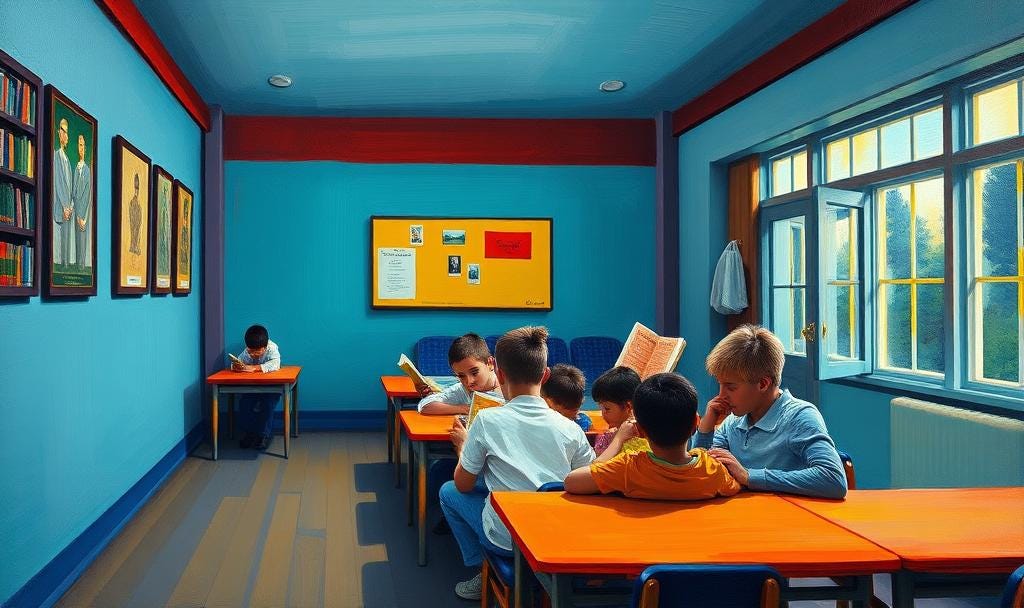
Recently a six- year old I know said “My teachers are too busy for my stories”. When I heard this, I was struck by the disappointment in the words and they left me wondering what might be “going on” for this child, at this point in time in their formal education. I also reflected on whether their experience might be similar to other 6 year olds in our education system, or even for those earlier in our history.
In 2024 structured literacy was mandated by the current government as the official approach to teaching literacy in Aotearoa/NZ schools. With its systematic focus on explicit instruction in phonics, grammar and decoding skills, structured literacy has been sold as a simple solution to addressing the “gap” in literacy achievement for many of our students. It has been praised for its effectiveness in addressing learning difficulties such as dyslexia (which affects around 10% of the population). But while it serves some students well, a growing number of educators and researchers are questioning its dominance – and its unintended consequences.
A rigid, one-size-fits-all approach to teaching reading and writing isn’t just potentially damaging — it can limit children’s creativity, identity, agency and voice, and restrict the ways they engage with literacy learning. Good schools and teachers recognise the cultural context in which their students operate and the strengths the diverse communities bring to their learning. They draw on these strengths to promote creativity and innovation, respect for the principles of Te Tiriti, the celebration of cultural identity and the multiple ways of expression among tamariki/rangatahi. Students’ strengths are demonstrated through their agency, along with the confidence to voice their ideas as individuals. At a time when our students need to prepare for ‘how to be’ in an uncertain world, we still have many schools that reflect an industrial, 20th century model of teaching and learning, suited to when I went to school.
This is not just about a single, frustrated six year old whose first year at school has not allowed her to continue to explore her creative ideas in reading and writing. It’s about all children who have been let down by a system that still doesn’t know who it is failing and how to address that failure.
In this article, I critically consider a recently implemented Government policy and practice in Aotearoa/New Zealand schools aimed at improving literacy outcomes. The potentially damaging effect are discussed and the article concludes with a call for balance in teaching reading and writing to meet diverse needs and the right for children to express their identity and voice.
The Policy Context
Information about New Zealand’s performance in the Programme for International Student Assessment (PISA) assessments in reading (2022) was used selectively by the current government during the election campaign in 2023 to promote their narrow focussed policies in education. In this report, Aotearoa/NZ students who are from higher socio-economic backgrounds are achieving at a higher level than their counterparts in other OECD countries. The students who are not achieving as well here are represented in the lower socio-economic brackets, but the gap between the socio-economic brackets here is shamefully wider than it is in most other similar OECD countries. Māori and Pacifica students are over-represented in this category.
Historically, Māori have experienced repeated attempts to erase their language and knowledge systems from education. From the assimilationist policies of the 19th Century (“Survival of the fittest” era) to the marginalisation of Mātauranga Māori in modern schools, the pattern is clear.
Post-1989’s “Tomorrow’s Schools” reform, when schools became self-managing, the system saw increased inequity, ongoing Māori and Pacific underachievement in mainstream education, growing staff burnout and the inability and lack of resourcing to develop schools fit to meet the needs of young people in the 21st Century. The lack of resourcing included the demise of advisors and curriculum experts from Colleges of Education (who provided support for teachers across the curriculum, particularly in literacy, numeracy and science) and changes in pre-service and in-service training of teachers. Removing the layers of support for schools and teachers over time is a key factor in driving educational failure. A mandated, prescribed programme such as structured literacy will not support the skills teachers need to acquire in order to know how to notice, and what to notice, about their students’ capabilities.
Structured literacy is based on international models, notably from the UK where after two decades of use overall reading outcomes still lag behind Aotearoa/New Zealand’s. The method is based on teaching a strict phonics approach in the early years of schooling to the exclusion of all other methods. The rhetoric surrounding the campaign to adopt structured literacy here was similar to the UK, setting up ‘them‘ (progressives) and ‘us’ (traditionalists) camps. In Aotearoa/NZ our two camps were considered to be those who supported what was called the ‘whole language’ approach and those who backed the ‘phonics’ approach. This is not to say that teaching phonics and phonemic awareness are not important, but the simplistic labelling of how to teach reading and writing undermines the importance of well-informed debate and shuts down the views of diverse groups. We need to remember that we do not all learn the same way and structured literacy will not be the solution to the complexity around inequitable outcomes in our education system.
The reintroduction of structured literacy in Aotearoa/NZ, along with the growing social and economic inequity for over 40 years, raises questions about whether education has regressed to a model once again focused on “survival of the fittest.” In trying to close the gap, the government has mandated a one-size-fits-all solution – one that risks overlooking the strengths and needs of the very children it aims to help. So the question remains, why are we adopting an approach that has not had proven success over time, in this country or the countries who have implemented it?
Ignoring Context, Culture, and Creativity
The current Government’s policies across a range of areas (education, health, housing, justice, training and employment) do not respect the rights of Māori to determine what works for them to be successful. When Māori took back the right to educate their children through the Kohanga Reo and Kura Kaupapa models of learning, where children are steeped in their language and Mātauranga Māori, we see how those students thrive. Within the mainstream education system we know that what works in terms of effective learning for Māori are relationships based on high expectations, content that is relevant and cultural responsiveness. This also works for many other students. However, our mainstream education system continues to ignore the cultural bias inherent in a one-size-fits-all approach such as structured literacy. There is no evidence based on longitudinal studies that this will work for the majority of our students.
This approach sidelines diverse world views in favour of a colonial approach to teaching reading and writing in English. It is characterised by its organised and sequential approach. Lessons are planned to follow a progression—often starting with letter recognition and sounds, moving through explicit phonics instruction and culminating in controlled reading and writing exercises. The teacher guides students step-by-step, ensuring mastery of each component before moving on to the next, regardless of what children already know (including the structure of their own home languages).
The approach limits children’s exposure to “authentic texts”- aka books that have an engaging story. In Aotearoa/NZ we have produced our own authentic texts for over 100 years, using the talents of our own writers, and these books have been published in Te Reo Māori and Pacific languages. Now our classrooms are being flooded with “decodables”- texts that just focus on the sounds and worksheets to practice them. They mainly come from overseas and, of course, are only in English. Students are not required to draw on their own experiences or knowledge to make sense of the text in a “decodable” so it begs the question what on earth do students think reading is, in their first years at school?
A growing body of research suggests that creativity and literacy are deeply interconnected, and that fostering one can support the development of the other. Studies have shown that children who engage in creative storytelling, poetry and dramatic play often demonstrate stronger language skills and higher levels of reading comprehension. Aiono (2024) argues
Children have tremendous capacities for innovation, yet current and proposed educational policies will fail to nurture these talents. Creativity is as important in education as literacy and should be treated with the same status. However, policymakers are doubling down on academic achievement and standardised teaching and testing, which narrows the focus and stifles creativity and risk-taking.
This policy and practice also ignores the need for teachers to be innovative and creative in teaching literacy and to integrate it across all learning areas. Doing so will enable learners to be creative, critical thinkers in both primary and secondary schools.
Identity, Agency and Te Tiriti Obligations
In the context of Te Tiriti o Waitangi and the increasing embrace of Te Reo Māori in schools, it is concerning that our national literacy policy ignores diversity. Cultural Responsiveness is not a “nice to have” - it’s a right. Yet, under structured literacy, the teaching of curriculum becomes uniform and the message to children is “Who you are doesn’t count” - or - “I’m too busy for your stories”.
An example of this is the Ministry of Education’s recent announcement that a popular, relevant early reading text (At the Marae) will not be reprinted because it contained too much Te Reo Māori and isn’t in line with the “scope and sequence” of phonics learning in English. Subsequently the Minister has announced that all Māori words will be removed from new readers for new entrants.
This undermines our commitment to an education system that honours identity and agency. From my experience children arrive at school as storytellers, knowledge holders, problem-solvers. They are not blank slates. When teachers don’t recognise that transitions from Early Childhood Centres to primary or from Intermediate to Secondary schools become moments of loss rather than progression.
It is the role of teachers to continue to grow children’s agency in the learning environment so they have the power and choice to make decisions and take meaningful action in their learning. We are seeing a return to classrooms where students are merely passive recipients of information waiting for teachers to tell them what to do and how to do it rather than the active participants in their learning. This does not respect the potential of learners or develop their agency.
The Science of Reading -or the Politics of Convenience?
Structured literacy is often justified by a theory called the “Science of Reading”. The theory draws on conclusions from our growing understanding of knowledge of how our brains develop and work but then makes generalised assumptions that a simple teaching practice will work for all students. The label has become a slogan to be used as a slam dunk against other theories or research in any discussion about the merits of structured literacy, with the implication that contrary opinions must be unscientific.
However, there is no such thing as the science of reading (or the science of learning for that matter). Guy Claxton has identified 10 multidisciplinary sciences that delve into how humans learn, all of which throw different lights onto how children learn. Shouldn’t we reflect that diversity of thought in our teaching and learning practice?
It seems that a significant number of principals and teachers in Aotearoa/NZ have been completely wowed by the science of reading or science of learning theories, along with the programme itself. I sometimes wonder if the attraction of structured literacy for some is that it is a pre-packaged deal - a way to make the job of teaching manageable and simple. The expectation that teachers will be culturally responsive is no longer required, which seems to sit well with our current government’s view.
When we strip away flexibility we deny teachers the ability to exercise the necessary professionalism to meet their learners as individuals with histories, identities and voices that matter.
The Unintended Consequences of Structured Literacy
The regimentation being imposed through structured literacy is likely to have a number of unintended consequences that will create greater inequities.
It may help with the technical skills of reading, but an over emphasis on those skills can also narrow what counts as success. Repetition and rote learning crowd out rich, open-ended literacy experiences, particularly when working with relevant tasks in a range of subjects, in local contexts.
Creativity may suffer also. In my opinion when children’s story telling is replaced with formulaic writing tasks such as copying a teacher’s story from the board, or excessive handwriting activities with an emphasis on accuracy, they are unlikely to take risks with their own story writing . They may lose the writing avenue for sharing their imagination and making sense of what they have heard or read.
Over the years I have observed children who excel in analytical thinking, while others shine in artistic or interpersonal interactions. Some may not share their thinking at all. That doesn’t mean they are not capable of it. Structured literacy, with its focus on a narrow band of skills, risks neglecting these multiple strengths. Children who might otherwise thrive in creative language activities may be left feeling disengaged or even discouraged if their talents are not recognised. In addition to students who need specific learning strategies to give them a good foundation to be able to read and write, we need to provide for literacy learning across contexts (science, maths, technology, social sciences, the arts, PE and health). A focus on a narrow band of skills is holding back students who might be capable of reading beyond the early stages of structured literacy. This may inhibit the love of reading which is inherent in the Aotearoa/NZ English Curriculum.
The risks for many children are a loss of confidence, joy and creative risk-taking-just when our learners need these skills the most. We know that creativity and literacy support each other, why are we choosing methods that constrain both?
A Call for Balance
The current Minister of Education, informed by her Ministerial Advisory Group, is leading the ‘them’ and ‘us’ rhetoric to discredit anything other than a structured literacy approach. The term a ‘balanced’ approach is misrepresented by putting it in a “whole language” camp and associating it with ‘woke”, “progressive” or, as one academic called it, “phooey” (Prof Chapman 24th March 2023 during Nine to Noon interview). However, the results for the majority of students in Aotearoa/NZ (according to PISA) is that a balanced approach does work. What is not working for many of our students are culturally-biased teaching practices based on teacher assumptions, low expectations and a lack of knowledge and respect of who they are. This is unlikely to change with structured literacy, which is based on the premise that we all learn the same way.
This is further supported by Wyse and Bradbury’s 2022 UK research which concluded:
“The teaching of phonics and reading in curriculum policy and practice should more closely reflect the evidence that contextualised teaching of reading, or balanced instruction, is the most effective way to teach reading”.
Balanced literacy in Aotearoa/NZ, once supported through successful, research-based initiatives like the 2004-2009 Literacy Professional Development Project (LPDP), set expectations of teachers and principals to continually reflect on whether their literacy teaching strategies were working for all students and to modify their approach when necessary. A balanced literacy approach respected the unique contexts and cultural makeup of our communities. In many ways we don’t need the UK’s failed experiment to teach us that. Our balanced literacy approach included a good understanding of the structure of language, the importance of comprehension and critical analysis of text at all ages. LPDP was not implemented across all schools despite its successes. It was abandoned by the government in 2009, at a time when teachers needed it most. In the years that followed (2010 -2022) we see the greatest decline in literacy achievement.
The damaging effects of structured literacy are not inevitable. The issue isn’t phonics per se – it is rigidity and exclusion. A balanced approach can address the structure of the language while reintroducing the creativity of story-telling, making meaning and critiquing the writer’s message.
We need literate classrooms at all levels that are full of:
Opportunities for creative writing: allowing children to invent stories, write poems, and explore language without concern for correctness in every draft.
Storytelling and dramatisation: encouraging oral storytelling, plays, and dramatic interpretations of texts along with the skill of argument to bring language to life.
Flexible assessment: evaluating student work based not just on accuracy, but on originality, effort and engagement.
Integrated curriculum: connecting literacy with art, music, science and social studies to show students that language is a tool for comprehension and creative thinking whatever the subject or context.
Critical thinking: interrogating text, examining the author’s and illustrator’s message, evaluating the quality of information
Support for all learners: recognising and valuing diverse strengths by providing opportunities for students to develop agency in their literacy learning and ensuring that structured elements do not overshadow the creative potential of every child.
Conclusion
I have tried to unpack why a 6 year old thinks their teachers are too busy for their stories. Do we, as primary or secondary teachers, respect what learning has taken place in each child’s life before they come to school? Do we know how many conversations, questions and experiences they have had which might contribute to their own story-telling, sharing of ideas and arriving at possible solutions to issues? Do we continue to build on those experiences to help them read and write about what they are interested in, or do we opt for a one-size-fits all structured approach that says they are not capable of certain skills until the teacher decides, (based on a narrow set of, sometimes culturally-biased, observations).
We owe our children more than phonics and decodable readers in the early learning years. We owe them space to share their stories, providing opportunities to explore how they can share their creativity through rich texts and learning experiences and the time to share that creativity in art and writing as soon as they can make marks on a page.
For every child, their story is a celebration of who they are and it is their right to tell or write it, so start making time and space for them to share their voice.
Michele Whiting. MA Educational Administration
MNZM
Fabulous article Michele! Have you sent it to mainstream print media?
Bravo! The next question is how we turn things around before it is too late. How do we depoliticise education so we have a consistent approach that is based on the needs of all our tamariki?