

Irony
By Marianne Malmstrom

Marianne Malmstrom is a teacher and learning architect. 45 years across Japan, the US, and Aotearoa.
The rest of the world is turning towards a human-centred learning approach at the same moment New Zealand is abandoning it.
AI technology is not coming. AI, as an emerging technology, is here and has already reshaped the world we all live in.
AI can currently outperform humans at many tasks done by well-educated professionals. This alone requires all of us to be asking the question of how we prepare students to succeed in an AI-shaped world when the future is so unpredictable that even the architects and engineers do not fully understand what they are building. It raises the question, “What is school for?”
For clarity, in this post I will refer to three different versions of the New Zealand National Curriculum developed and/or deployed over the last two decades. They are as follows:
2007 New Zealand Curriculum (2007 NZC). Developed and adopted after three years of consultation with all stakeholders: parents, educators, students, community groups, businesses, and the NZ Roundtable. It is a human-centred curriculum that follows OECD recommendations.
2023 Te Mātaiaho Refresh. Developed in genuine partnership with Māori, and shaped by extensive consultation with rangatahi, whānau, iwi, hapū, educators, and communities. Designed to refresh the 2007 New Zealand Curriculum, giving effect to Te Tiriti o Waitangi and ensuring inclusion for all ākonga. Due to a change in government, the draft was never enacted.
2025/26 Draft New Zealand Curriculum (2025/26 Draft). A standardised, knowledge-focused curriculum built around “Structured Literacy” and “Science of Learning” theory. It introduces mandated teaching sequences, prescribed content, and standardised testing as the primary measure of student success. Schools have already been required to implement portions of the draft. The full curriculum is still under development.
I recently submitted my professional critique of the 2025/26 Draft to the Ministry of Education after teachers were invited to provide feedback. Read my submission here:
Malmstrom Submission on the Year 0–10 Draft National Curriculum (2026)
Reviewing the draft, I anticipated the mandated shift from human-centred to content-driven curriculum. What I didn’t expect to find was the MoE’s unethical use of the 2023 Te Mātaiaho Refresh as gift wrap to present their 2025/26 draft. The two frameworks could not be more incongruent. By appropriating the former to promote the latter, the Ministry demonstrated blatant disrespect and disregard for a gift that it was entrusted to protect.
Te Mātaiaho was gifted by Dr. Wayne Ngata and Rōpū Kaitiaki to bring the 2027 National Curriculum into alignment with Te Tiriti o Waitangi. It was a taonga to be held in trust, a trust that was betrayed when the Ministry rewrote the document through erasures and substitutions. They literally changed the definitions of te reo concepts.
Understand the meaning of Te Mātaiaho.
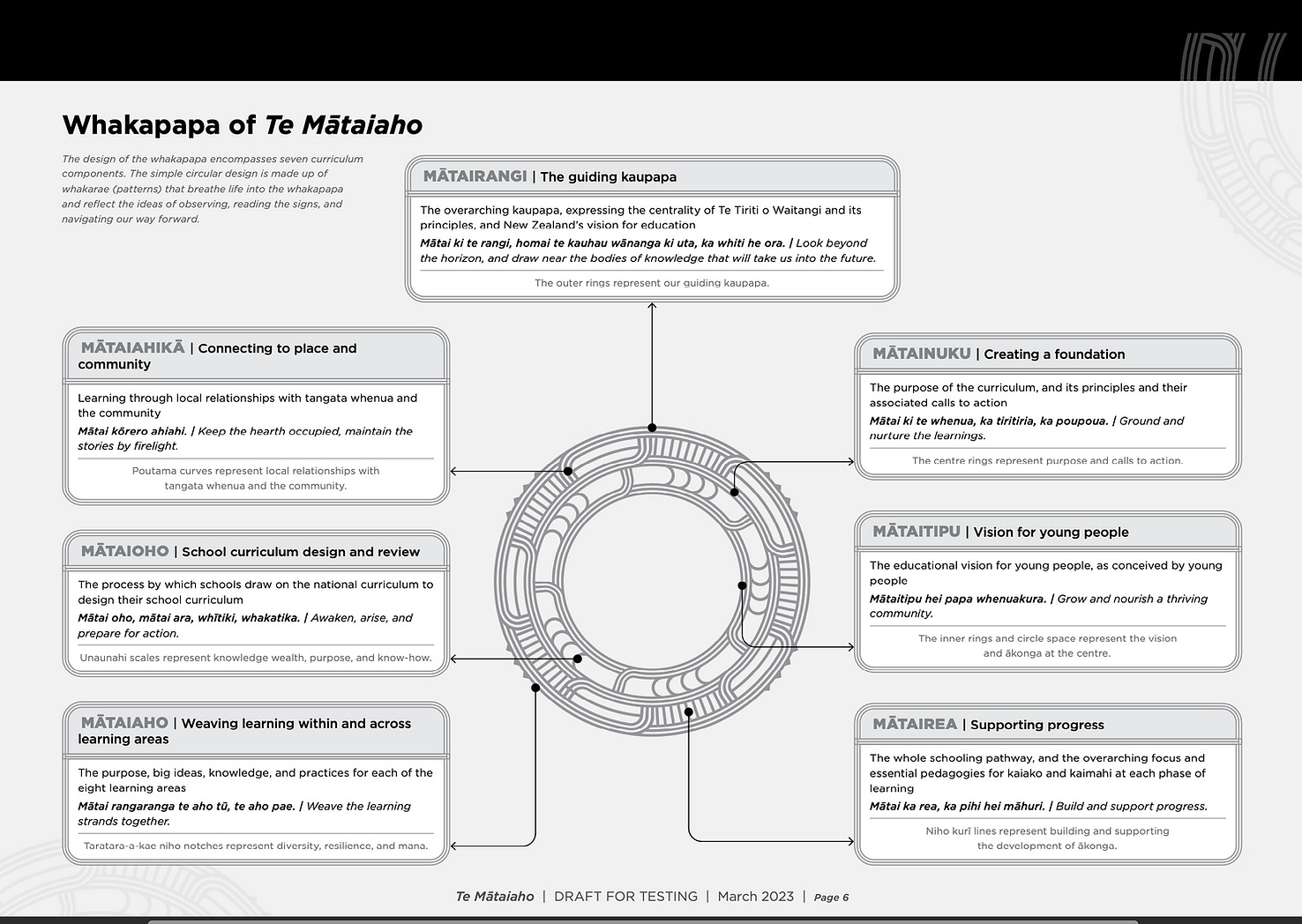
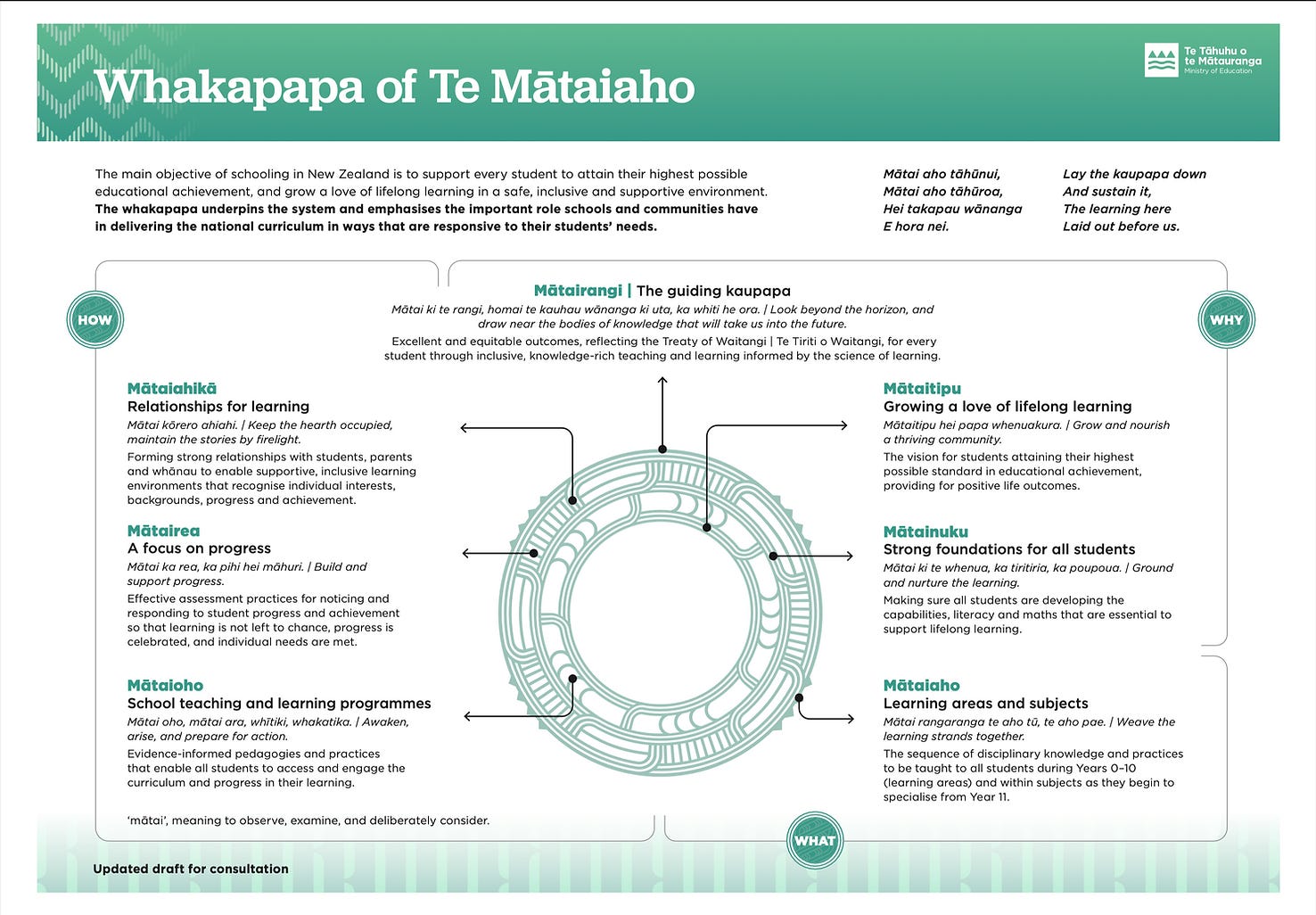
See how the Whakapapa was changed.
ORIGINAL 2023 Te Mātaiaho Refresh Draft Whakapapa
“NEW” 2025/26 Draft
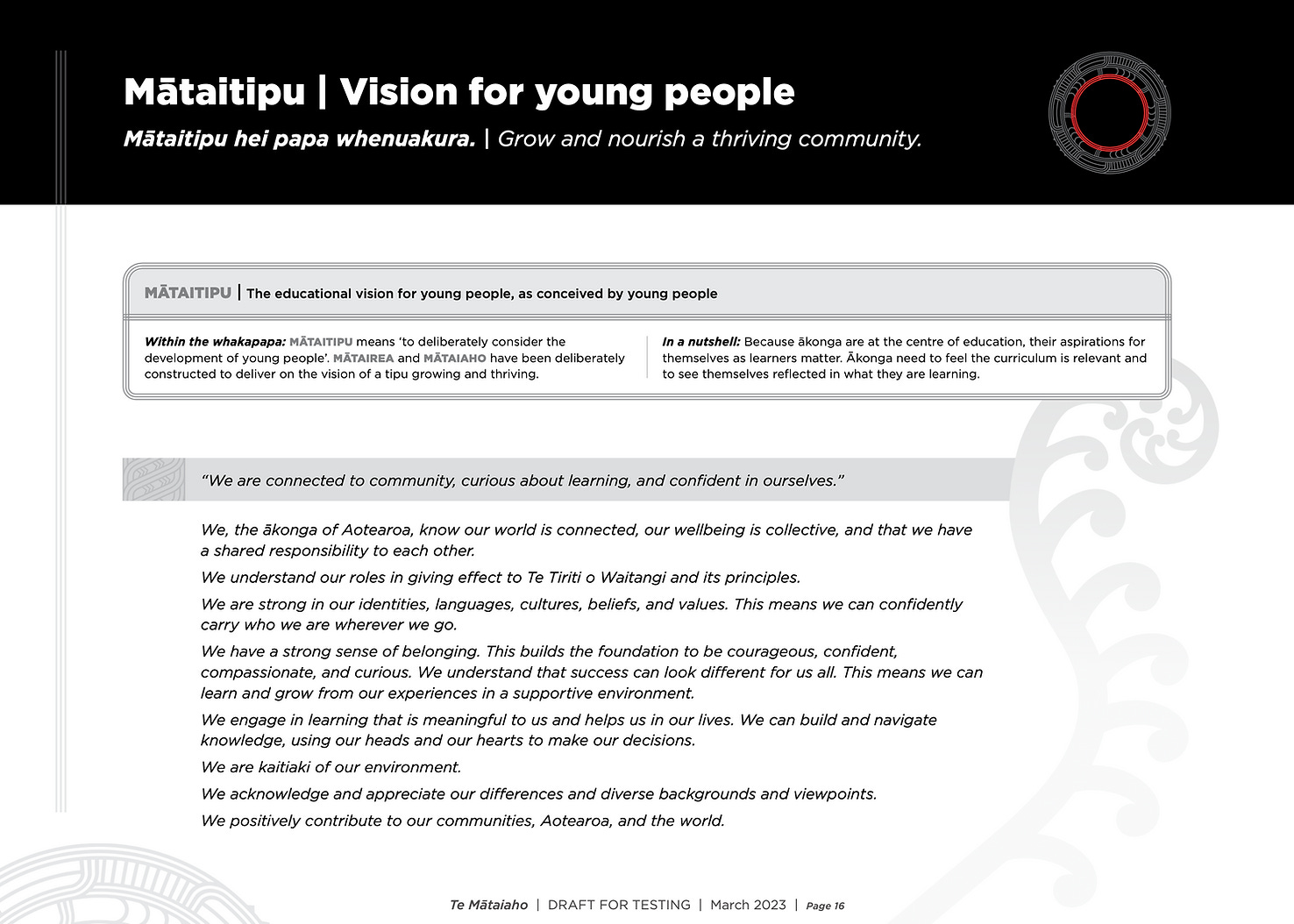
Read the student voice that was erased.
Mātaitipu | Vision for Young people as conceived by young people
These changes matter. They are erasures of a human-centred guide to education, placing youth at the centre of every decision. They are erasures of way markers constructed to guide students and educators through profound change. They are erasures of what it means to be human... a question scholars, philosophers, ethicists, and even the business sector are grappling with as the world is increasingly reshaped by AI.
How do we keep learning relevant?
I have spent my career chasing the question of relevance in learning. I chose to move to New Zealand because I found the 2007 NZC to be one of the most future-focused frameworks I had encountered in my quest to design pedagogies and curricula that could withstand unpredictable change. That single question, “How do we keep learning relevant?”, successfully guided me through three decades of designing learning strategies for emerging technologies reshaping our world.
It is no longer enough to address the changes we are living through.
AI is different.
Unlike other digital technologies, AI encroaches on the domain of human identity.
Trained on vast amounts of digitally captured human knowledge, AI is designed to “sound” and “feel” human. It starts to profile us every time we engage it in conversation. AI shapes its responses to please us by using mirroring techniques to feel familiar and friendly. While it can’t (yet) think like humans, it can perform incredibly sophisticated computational tasks that emulate human cognition.
AI is outperforming humans at increasingly difficult tasks. Well-educated professionals are starting to see AI encroach upon their fields of expertise, causing concerns about the future of their jobs. Even education, which changed very little through the last three decades of emerging technologies, is now being forced to deal with a digital technology that cannot be schoolified. Teachers are under pressure to rethink how they teach as AI disrupts traditional paradigms. Students are turning to AI to offload homework with no reliable way for teachers to check authenticity. The same tools that free students from homework also enable them to learn about what interests them. AI is a powerful learning and creation tool that teachers and students are both figuring out.
My driving question of relevance is no longer enough to effectively guide us through this kind of change. When AI can outperform us, imitate us, and even “feel” like us, the question we all need to answer shifts.
What does it mean to be human?
Both the 2007 NZC and 2023 Te Mātaiaho Refresh Draft provided answers to this question, long before it was explicitly asked.
The 2025/26 Draft does not.
It fails to address either the question of relevance, or how to prepare students to succeed in a world where the line between human and machine is increasingly blurred. At the very moment students need to hone capabilities that are intrinsically human, the 2025/26 Draft delivers a curriculum better fit to train AI.
What is school for?
If schools are truly meant to prepare students for success, the Ministry of Education has not only delivered the wrong curriculum, it has failed to provide leadership in preparing NZ schools to safely, ethically and effectively implement AI for learning.
The Ministry has had two years to respond to the most significant technological shift in generations. Instead, it has offloaded that responsibility to individual schools while delivering a national curriculum no longer fit-for-purpose.
Meanwhile, the international field has not been idle. UNESCO, the OECD-EC framework feeding PISA 2029, RAND, Brookings, and NYC Public Schools have converged on what AI literacy actually requires:
Engaging with AI,
Creating with AI,
Managing AI,
Designing with AI.
The pedagogical conversations are evolving from: ‘Should students use AI?’ to ‘Are students using AI for cognitive offloading or cognitive augmentation?’ These questions will continue to evolve as educators and students learn more about AI.
Schools doing this work have abandoned binary policies in favour of frameworks focused on honing human capabilities, dispositions and capacities to help students discern risks, accuracy and manipulation.
None of these conversations are happening through the 2025/26 Draft. AI appears in only one sentence. That sentence sits in the Computer Science strand, which is one of five strands offered at Years 9 and 10. Students can choose only two of those strands. That literally means that a New Zealand student can complete every year of the 2025/26 Draft curriculum without being required to engage with AI in school.
The most striking gap is closer to home. Aotearoa has produced genuinely world-leading thinking on indigenous AI ethics that have shaped international frameworks:
Dr Karaitiana Taiuru’s Te Tiriti Based AI Ethical Principles
Pacific Data Sovereignty Network (advocacy body)
Moana Research (founding Pacific-led consultancy on PDS)
Pacific Data Fale o Aotearoa (data platform)
The country that helped write the global standard has not yet made it operational at home.
This is the work the Ministry should be doing right now, not replacing the 2023 Te Mātaiaho Refresh with workbooks. Not offloading the responsibility to develop AI policies, nor the liability for ensuring student data is stored safely within New Zealand.
The offloading is not abstract. Every school in Aotearoa is now expected to write its own AI policy with little to no guidance, resources, or support. Embedded in those policies is legal liability for Privacy Act 2020 compliance, the thirteen Information Privacy Principles overseen by the Office of the Privacy Commissioner, and Te Tiriti-grounded data sovereignty obligations. Schools are being asked to carry obligations the Crown itself has not operationalised.
Meanwhile, student data flows offshore through commercial AI tools into jurisdictions where neither the Privacy Act nor Te Tiriti has any force. This is not a future risk. It is the current operating reality of every school using AI without a national infrastructure to support it.
Education Minister, Erica Stanford, has acknowledged publicly that the Ministry “aren’t giving great guidance and advice” on AI. She has also confirmed her Ministry is, in her own words, “up to their eyeballs” rewriting curriculum. The choice has been made. The wrong work is being done. The right work is being deferred.
What is school for? The Ministry has answered this on behalf of every Kiwi by presenting us with a curriculum designed for a school that no longer exists. It fails to prepare our students for the unpredictable future they face. Worse, it fails them in the world they already live in.
You can read more of Marianne’s blogposts at: https://www.followthelearning.com

I posted length about 1950, The Human Use of Human Beings. The Riverside Press (Houghton Mifflin Co.).-- available now as a free .pdf -- a book on the dangers of automation
of AI -- predicted in 1950 - by Ione of the first inventors of Cybernetics recommending reading it --- by everyone engaged with the New Curriculum and attemots to impose it onSchools b ut mysteriously I can find no trace of my post ---as seemingly DE>LETED by unknown persons.
Thanks Marianne for the insightful analysis. As Eric Hoffer wrote, "In time of change the learners will inherit the world, while the knowers will be beautifully equipped for a world that no longer exists."