

IMPORTANT UPDATE - System Reform Bill: When Reform Isn’t Really Reform
Why Educators Should Be Deeply Concerned About The Education And Training (System Reform) Amendment Bill That Just Dropped


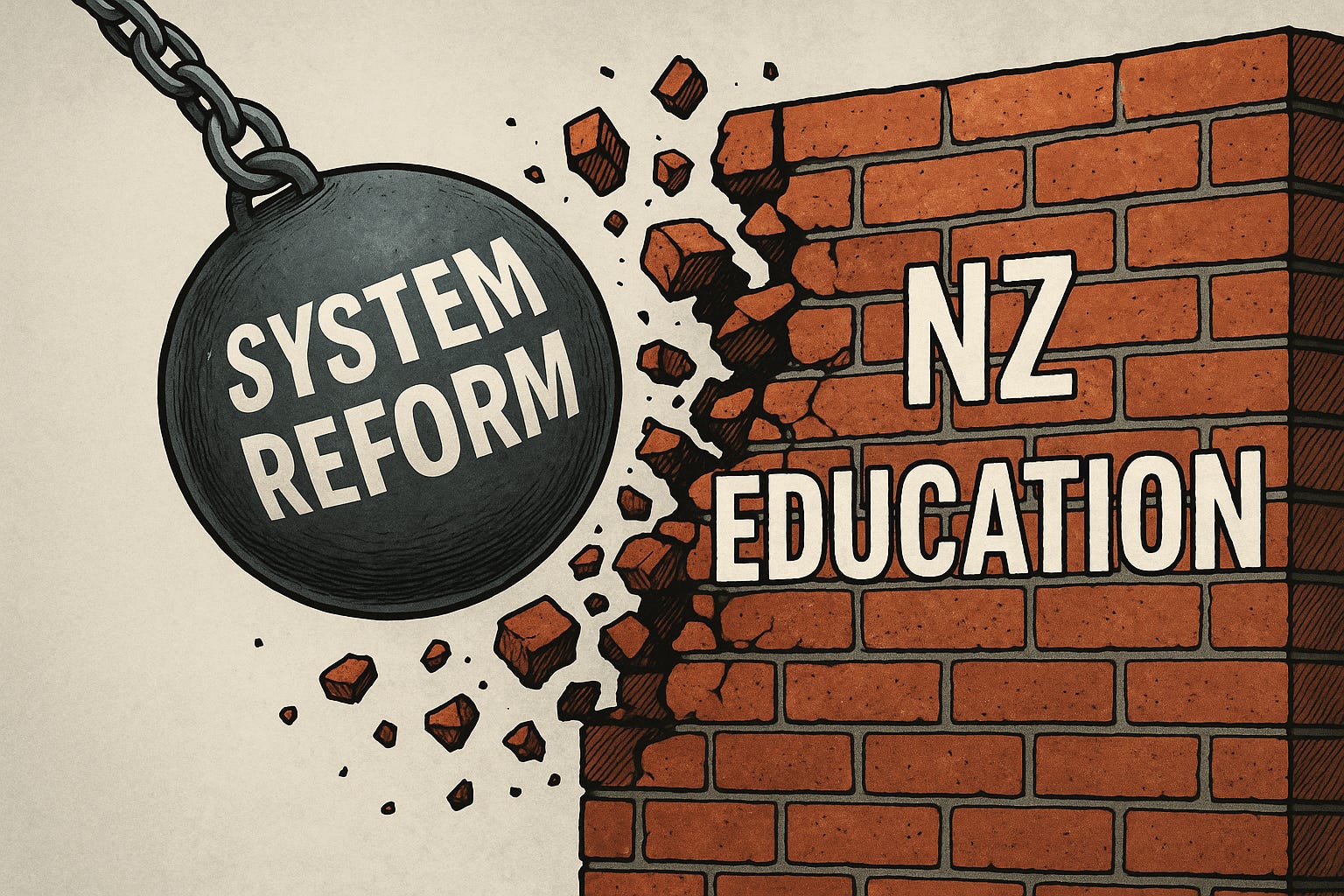
Over the past few months, many of us have been watching the Education and Training Amendment Bill developments with growing unease. On the surface, it promises “efficiency,” “clarity,” and “better outcomes.” But when you look closely (really closely) you see something far more significant unfolding.
Yesterday (17th November, 2025) a further bill was published - The Education and Training (System Reform) Amendment Bill.

This Bill is not a tidy tune-up of the system we know. It represents a fundamental philosophical shift in who controls education in Aotearoa, whose voices matter, and how schools are expected to operate.
And if it passes, the implications for teachers, school leadership, and our young people are profound.
This is not scaremongering. This is an evidence-based reading of what the Bill actually does.
So let’s talk plainly about what’s at stake, and why teachers should care deeply.
The Quiet Undermining of the Teaching Profession
Perhaps the most troubling change is the transfer of responsibility for teaching standards, registration criteria, practising certificate criteria, and even the teacher Code of Conduct from the Teaching Council to the Secretary for Education.
What does this mean in reality?
It means teaching standards become political instruments.
It means registration requirements can shift with the ideology of the government of the day.
It means the independent, profession-led voice that should shape our values and expectations as educators is reduced to a compliance arm of the Ministry.
And just to cement this diminished role, the Teaching Council will shrink from 13 to as few as 7 members, with only three elected teachers and all other members appointed directly by the Minister.
This is not about raising the status of the profession. In fact, the Bill literally removes that responsibility from the Council’s purpose statement.
This is not reform. This is centralisation. This is about control.
Curriculum Control Shifts to the Beehive
The Bill gives the Minister sweeping powers to amend curriculum statements, even without a review, even without consultation, and allows different curriculum statements for different types of schools or groups of students.
We should all pause at that.
A differentiated national curriculum? One that can vary depending on school type or student grouping?
This opens the door to tiered schooling and the quiet erosion of equity. It is also a significant shift away from the spirit and flexibility of the 2007 New Zealand Curriculum, one of the most progressive, student-centred frameworks in the world.
In addition, the Bill removes the requirement for schools to consult their communities about their health curriculum. They simply need to “inform.”
This is not partnership. This is not co-design. This is not aligned with Te Tiriti.
This is centralised prescription dressed up as efficiency.
The Rapid Expansion of the Charter School Model
The Bill makes it easier for charter school operators to run multi-school contracts, essentially enabling charter chains. It also ensures that if a charter operator pulls out, a new State school must be established in its place, smoothing the pathway for rapid turnover and expansion.
International evidence tells us this is how large-scale privatisation of public education begins: quietly, administratively, through “efficiency frameworks” that shift decision-making away from local communities.
And once it starts, it is very hard to unwind.
A New Super-Agency for School Property
The creation of the New Zealand School Property Agency (NZSPA) lifts property control out of schools and the Ministry and places it into a new Crown entity. This agency will have authority to:
enter school sites
carry out maintenance and charge schools for it
issue interventions for property issues
require schools to provide information
influence capital planning and development
In other words, another layer of oversight and compliance, without addressing root causes like chronic under-funding of maintenance, ageing stock, seismic requirements, and the sheer complexity of running a modern school.
Property is not just infrastructure. It is culture, identity, safety, and belonging. When decisions are made far from the people who live in our spaces, we lose the ability to shape environments that reflect our communities.
ERO Becomes Faster, Stronger - and Potentially More Punitive
The Bill requires ERO to notify the Minister within two days if they believe a school is “of serious concern,” and to recommend an intervention within 28 days.
This accelerates the path from review to intervention and significantly increases the role of the Minister in the life of individual schools.
We all value accountability, but accountability without relational trust becomes surveillance.
When schools are pressured to avoid negative judgements at all costs, they stop taking risks. Creativity suffers. Innovation suffers. Equity suffers.
And most importantly, learners suffer.
Attendance Becomes a Compliance Tool, Not a Holistic Strategy
Principals will only be allowed to grant attendance exemptions under strict, centrally created rules. Gone is the professional discretion that takes into account context, relationships, and pastoral knowledge.
Despite what headlines suggest, compliance has never solved attendance issues - relationships do. Support does. Resourcing does. Addressing poverty and wellbeing does.
This part of the Bill is a solution in search of a headline, not a solution in search of understanding.
So What Does All This Mean?
Together, these reforms signal a clear, deliberate shift in the philosophy underpinning our education system:
from local to central
from profession-led to politically led
from flexible to prescriptive
from partnership to compliance
from public to increasing privatisation
from holistic wellbeing to measurable outputs
This Bill is not a response to what currently challenges our system; it is a re-engineering of the system to reflect a narrow ideology that is increasingly out of step with evidence about effective learning, equity, and the future of work.
Why Educators Must Speak Up - Now!
If we remain silent, these changes will become the architecture of schooling for the next generation. Once embedded, they will shape:
who gets to thrive
what counts as “learning”
how teachers are viewed
what communities can influence
and ultimately, the kind of society we are preparing young people for.
This Bill is not just administrative. It is cultural. It reshapes the values that underpin education in Aotearoa.
A Call to Action (yes, again)
Educators - kaiako, leaders, support staff, boards, whānau we cannot sit this one out.
Here’s what we can do:
1. Talk about the Bill.
Discuss it in staffrooms, PLD, department meetings. Knowledge is power.
2. Make submissions.
Even if the window has closed, public pressure matters. Write to MPs, local boards, unions, media.
3. Mobilise your community.
Parents need to know what is at stake. This is their children’s education.
4. Stand together.
Change is always easier to challenge collectively. Advocate through NZPF, PPTA, NZEI, SPANZ, AEC, DisruptED and other networks.
5. Hold fast to our values.
Nurture, inspire, empower. No one falls through the cracks. The heart of our curriculum is not up for negotiation.
Because the future of education in Aotearoa is too important to leave to politics alone.
A thoroughly articulated outline of the attack on our profession and the negative implication for learners. We need to heed this call to action!
For those who like data that goes deeper than political soundbites, it is worth a read through the OECD assessment of NZ education system released last year (p80-120). Seems the government is following the OECD evaluation and recommendations in some aspects, however it strongly advised against a centralised approach. And it also erodes trust across the whole system and takes us backwards since the global trend for future schools is in favour of decentralisation. 😢
"New Zealand should retain its decentralised education system. The decentralised system has many advantages and the solutions do not lie in recentralisation but better implementation of the current system. Recentralisation would involve a huge change, entail high implementation risks and add a further significant policy burden to the government. Experience suggests that even if such a reform wasimplemented, it would generate significant policy volatility as without the support of teachers, principals
and schools, it would likely be reversed in short order. Indeed, the underlying problem does not seem to be that a lot of schools are run poorly, providing a substantive reason for re-centralisation of decision making. Empirical evidence shows that school quality as measured by student achievements is remarkably uniform once socio-economic background of the children is taken account of (Hernandez, 2019). This is confirmed by the OECD data above that shows across-school variation in PISA performance is quite low by international comparison, while within-school variation is very high (Figure 4.3). Indeed, there is less segregation by socio-economic backgrounds across schools in New Zealand than the OECD average (OECD, 2023d). Insufficient local support to schools,
principals, and teachers to put policy into practice, as well as insufficient preparation of teachers to meet the needs of a wide variety of learners from varying backgrounds, likely negatively affect children in most schools across the achievement spectrum, but particularly the most socially disadvantaged and those with disabilities and extra learning support needs." --- OECD 2024 Economic Survey for NZ, p87