

Evaluation for school improvement? - Yeah right!

As a long-time principal in a high EQI school (previously ‘decile 1’), yesterday’s announcement about the Education Review Office’s (ERO) new school review model felt like a kick in the guts. This development may be a final straw; the last of a long list of changes and disruptions to curriculum, pedagogy and school leadership that have assaulted our professional integrity, expertise and respect in the past two years. For many school leaders the camel’s back of resignation or retirement is now a likely reality. I’m not sure how education in Aotearoa will improve, or even retain outcomes at their current level, if significant numbers of experienced principals, especially those leading high EQI schools, walk away from the job.
This may sound overly dramatic or reactive but we need only look to England, where the Office for Standards in Education (Ofsted) uses a very similar model for school evaluation. This approach has drawn plenty of criticism for damaging teacher and principal well-being, even to the extent that a Head Teacher took her own life in 2023. A coronial inquiry found her school’s Ofsted review, with it’s harsh labelling system, was the key factor leading to her ‘silent suicide’.
ERO calls their school review approach Te Ara Huarau (The pathway of many fruitful outcomes). This poetic name is consistent with ERO’s primary purpose as stated on the website:
We are The Education Review Office | Te Tari Arotake Mātauranga (ERO), the New Zealand government’s external evaluation agency that informs and facilitates improvement in early learning services, kōhanga reo, puna kōhungahunga, kura and schools.
And this is what we, in the education sector, have always understood as ERO’s raison d’etre: school improvement. Surely this should be the government’s primary goal given how much Vote Education money is allocated to ERO.
However, in April 2026 ERO’s purpose will shift to a service for parents. As Ruth Shinoda, Chief Review Officer (CRO), said on Radio NZ on 18th of March: “Previously the reports were predominantly written with schools in mind” - but obviously no longer. Is this another example of taxpayer money being used to please ‘Mum and Dad’ stakeholders for political advantage? Should we expect ERO to rewrite its mission statement?
For a detailed description and further commentary on the newly introduced ERO review reports see Claire Amos’s recent Substack article.
A report card inherited from England:
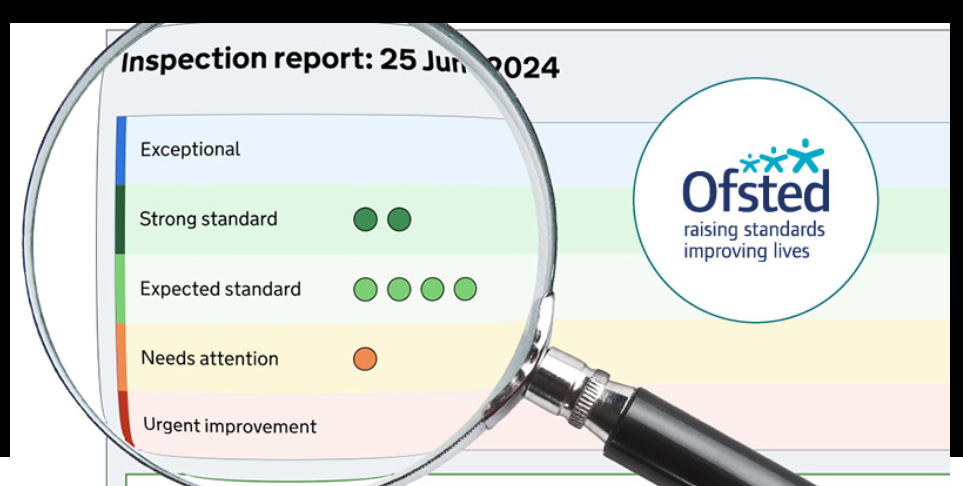
One only needs to view some current and recent Ofsted school inspection reports in England to see how similar our new ‘report cards’ will be. Perhaps it is no coincidence that the new CRO is from England, she does not appear to have any experience in the school sector here.
Although the more likely reason for the copycat model is that Minister Stanford is enamoured with Lord Michael Gove and Sir Nick Gibb and the political developments they introduced in England when in government - even if their policies didn’t actually drive educational improvement there. And there appears to be no positive impact of Ofsted’s inspection practice - in fact quite the opposite.
Like the English version, the new ERO reporting model reflects a high-stakes labelling system. It mirrors key features of Ofsted including colour-coded ratings, categorisation of performance, public-facing summaries and an emphasis on clarity for parents. Given the experience within the English education sector, if not challenged and replaced or modified, New Zealand will likely see:
increased pressure on teachers and leaders
performative compliance rather than genuine improvement
widening inequities between schools
reputational labelling that shapes public perception
limited impact on actual student outcomes.
Increased pressure for teachers and leaders
Research has long suggested that the policy of school inspection, implemented by Ofsted in England “has psychological and physical effects on teachers that can be defined as toxic”. (Calvert et al., 2025 - https://doi.org/10.1080/02680939.2025.2498892 )
In a 2019 Guardian article “Ofsted under fire in its own survey of teachers’ wellbeing” Geoff Barton, the general secretary of the Association of School and College Leaders, said “Ofsted and the government are the source of much of the stress and anxiety on staff through an extremely high-pressure accountability system.”
As mentioned above, on 8 January 2023, Ruth Perry, Head Teacher at Caversham Primary School in Reading, Berkshire, took her own life following an Ofsted inspection which labelled her school as “Inadequate”. Perry’s sister, Professor Julia Waters, said of Ofsted’s model, which includes the report cards with a five-point grading scale which NZ has copied:
“...[are just a] cosmetic rebranding, tweaking and expansion of the same unreliable and punishing system as the one before. It still puts school leaders at risk of public shaming, still means they may fear the high-stakes consequences of a bad inspection, still offers no structural safeguards against inspector misconduct, and still provides no credible independent appeals system. This proposed new regime may work for government bureaucrats, but it will continue to undermine the work of teachers and school leaders”.
In March 2023,The Guardian reported that research carried out by the Hazards Campaign in the UK and the University of Leeds found that “Stress caused by Ofsted inspections was cited in coroners’ reports on the deaths of 10 teachers over the past 25 years”. https://www.theguardian.com/education/2023/mar/25/revealed-stress-of-ofsted-inspections-cited-as-factor-in-deaths-of-10-teachers
Research has also found that these types of review reports do not lead to school improvement: there are almost no differences in future academic, behavioural, school leadership and parental satisfaction outcomes between schools rated as good, requiring improvement and inadequate in the inspection data. (Bokhove et al. 2023). Full article: How Useful are Ofsted Inspection judgements for Informing Secondary School Choice?
And von Stumm, S et al (2021) found that “Ofsted-rated school quality is a weak predictor of secondary-school outcomes at age 16, including educational achievement, wellbeing, and student engagement, once student characteristics have been taken into account. “. School quality ratings are weak predictors of students’ achievement and wellbeing - PMC
Back in Aotearoa:
I still have a lot of questions about the new review reports:
Where is Te Tiriti? Te reo and te ao Māori? Where is the focus on relational engagement, pastoral care and wellbeing? Social and emotional competencies? Creativity? Skills and knowledge needed for a changing global environment? Broader curriculum areas? Local Curriculum? Connection with whānau?
Internal self-review and evaluative capacity have been such a major focus for ERO over the last two decades: this seems to have disappeared.
But most of all: why repeat a system which didn’t work for school improvement in another jurisdiction?
High EQI schools in Aotearoa, like mine, do not need reports like these: we can easily find some red and orange crayons and colour in boxes for ourselves, perhaps one or two greens if we are lucky. https://www.engaginglearningvoices.com/post/ero-give-me-a-crayon-i-ll-do-your-report
We know what needs to be improved and what needs to be done. We know what lies beyond our gate and is outside of our control. We know what kinds of resourcing and support we need in order to improve. And that support is certainly not some Ministry of Education intervention, triggered by a red and orange shaded report. An external specialist, such as a statutory manager or a commissioner, who has no experience working in communities such as ours - paid for by the school and taking thousands of dollars from our already stretched operations budget. Money that could be going to reading books, pastoral support for our families and so forth.
It is a rare high EQI school that will need green crayons, for as the research tells us, most of the factors that impact education outcomes are external to the school (Pasi Sahlberg, UpliftEd Conference 2025)
These reports are not for us. They are not for school improvement. They may be for some parents - but not for many NZ communities where parents don’t often read ERO reports.
If they were for schools, educators would have been advised in advance… or maybe even consulted! We certainly would not have heard about this development for the first time in the media - before we received any communication from ERO.
I am convinced that this new model of reporting is primarily for political advantage, particularly useful a few months before an election.
I conclude with the words of education blogger Bee Thomas:
This new way of reporting will not just describe inequity: it will reinforce it.
Reading this excellent post again - it seems like this government is 'neutralising' NZ schools making our schools an excellent product with no responsibilities to provide anything more than a narrow curriculum