


Welcome back to Collective Matters.
Safer Classrooms Require Better Support, Not a Return to Outdated Behaviour Policies
The Aotearoa Educators Collective agrees with one important point raised in the current debate about student behaviour: Teachers and principals are desperate for greater support. However, ACT’s policy will not provide effective solutions; it is poorly informed.
Across New Zealand, educators are increasingly supporting children with complex behavioural, developmental, disability and mental health needs while specialist services struggle to meet demand. Teachers deserve safe classrooms, and every child deserves the opportunity to learn in an environment where they feel safe, connected and supported.
However, the solution is not to return to behaviour management approaches that research has repeatedly shown are least effective for the children with the greatest needs. Over the past thirty years, advances in developmental neuroscience have fundamentally changed our understanding of children’s behaviour. When children experience chronic stress, trauma, neglect, developmental differences or overwhelming sensory experiences, the lower regions of the brain responsible for survival become dominant while the higher cortical regions responsible for reasoning, impulse control, emotional regulation and learning become significantly less accessible. “A dysregulated child cannot be reasoned with until they are regulated.” – Bruce Perry. Punishment may suppress behaviour temporarily, but it does not build the neurological capacity for self-regulation. This should no longer be a philosophical, nor a political debate. It is neuroscience.
Teachers are asking for:
increased resourcing for teacher aide support in every class and additional staffing where complexity is greatest;
timely access to occupational therapists, psychologists, speech-language therapists and specialist behaviour support;
professional learning in neuroscience, co-regulation and effective de-escalation;
education policy informed by contemporary evidence rather than assumptions developed decades ago.
The safest classrooms are not created through stronger punishments. They are created by understanding how children’s brains develop, addressing the causes of dysregulated behaviour, and equipping schools with the resources needed to intervene early and effectively.
Event - A Vision for Education in Aotearoa New Zealand AEC report launch
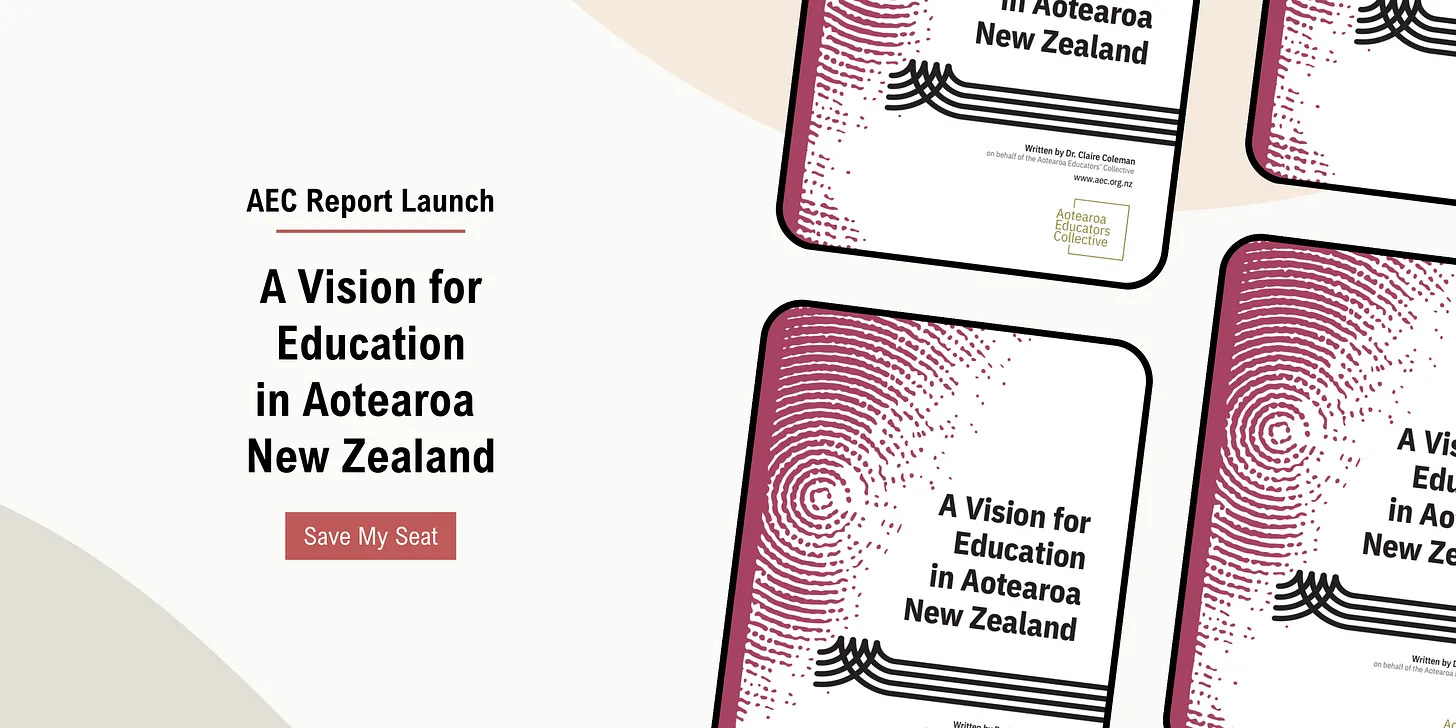
Join the Aotearoa Educators Collective for the launch of A Vision for Education in Aotearoa New Zealand, written by Dr Claire Coleman on behalf of the Collective.
Thursday, 20 August, 8:30am - 10am at the University of Auckland Arts & Education Building - Building 201
The morning will begin with a networking breakfast at 8.30am, followed by a presentation from Dr Coleman exploring the report’s vision for a more equitable, connected and enduring education system.
We will also be joined online by internationally respected education leader Anthony Mackay AM, former CEO and current Board Chair of the Washington DC-based National Center on Education and the Economy. Anthony is Deputy Chancellor of Swinburne University, an Honorary Senior Fellow at the University of Melbourne and a Visiting Professor at the University of Greater Manchester.
Anthony will share his insights into how the vision aligns with the thinking and direction of leading education jurisdictions around the world, and why developing a shared long-term vision matters for the future of education in Aotearoa.
Come along to connect with educators, leaders, researchers and others who care deeply about the future of our education system.
Be part of the conversation. Get your tickets here.
Event - AEC Happy Hour
A monthly online get-together for people who want to be part of professional dialogue. Join us on 27 August 7:00 pm to 8:00 pm.
The Problem? For a range of reasons, educators are not engaging in professional discussion and critique of education policy and politics. We are keen to provide a platform for small group conversation about what is going on in education. Just want to listen? - there is space for you, got lots to say? - there is space for you.
People can register through our flash new Zoom account.
Discussions will be book-club style, aiming for around 10 people per breakout room.
Get a sense of the discussion by checking out our one-pager of background reading.
How you can help
Help fund our work, join our Substack as a paid member.
We want to work alongside people to create content for the Substack. You do not need to agree with everything the Collective has said. But we do want to create a place for wide-reaching professional discussion. You can see more info here.
Become a collective member. Be listed on our website as a collective member and help build this movement.
Substack Summary
Here is the list of the published posts from July 2026 on the Aotearoa Educators Collective (AEC) Substack:
Tuesday, 28 July 2026 – Afterschool Special: Phase 5 Consultation Learning Languages Live with Claire Coleman – Read Article
Sunday, 26 July 2026 – School Briefs: SMART Reports offer no clarity, New ERO reports start to roll out – Read Article
Saturday, 18 July 2026 – Sunday Read: A Not-So-New Science of Reading – Read Article
Tuesday, 14 July 2026 – The SMART Tool Reports Are Out! Now With 100% More 1995 MS Paint Energy - not kidding – Read Article
Monday, 13 July 2026 – School readiness isn’t the finish line. It’s the starting point for life – Read Article
Sunday, 12 July 2026 – Education Isn’t What You Think It Is – Read Article
Saturday, 11 July 2026 – Sunday Read: Four futures for senior secondary qualifications in Aotearoa – Read Article
Thursday, 9 July 2026 – Collective Matters #20 – Read Article
Sunday, 5 July 2026 – Early childhood education is a public good – Read Article
Sunday, 5 July 2026 – School Briefs: SMART Reports launch, Attacks on ECE teachers, Term Break reading list – Read Article
Saturday, 4 July 2026 – The Curriculum Is Coming. The Questions Remain – Read Article
Thursday, 2 July 2026 – A Programme Is Not a System – Read Article