

A Curriculum Designed by New Zealanders for New Zealanders
A letter to school leaders

Dear Principal Colleagues,
The new English and Mathematics curricula are with us now - and as school leaders navigating the complexities of this new landscape we are doing more than just implementing new learning areas. We are exploring how we might fit the content into our local context and how we might design our delivery in a way that responds to te aruhei o te tamaiti: to the cultures, languages, experiences, interests, strengths and learning needs of our learners.
It is exhausting: but we are muddling through and beating back the overwhelm.
While this work is demanding, a more significant concern looms: the direction of future curriculum changes. Do we have a clear picture of what to expect for other learning areas, and even for ‘the refresh of the refresh of the refresh’ of English and Mathematics curricula, apparently to be released this term?
More critically, do we know who is shaping the future of education in Aotearoa? A closer look reveals that many of the key influencers are not from New Zealand, and their philosophies are often not reflective of our diverse society in Aotearoa. Many of these voices are not teachers…
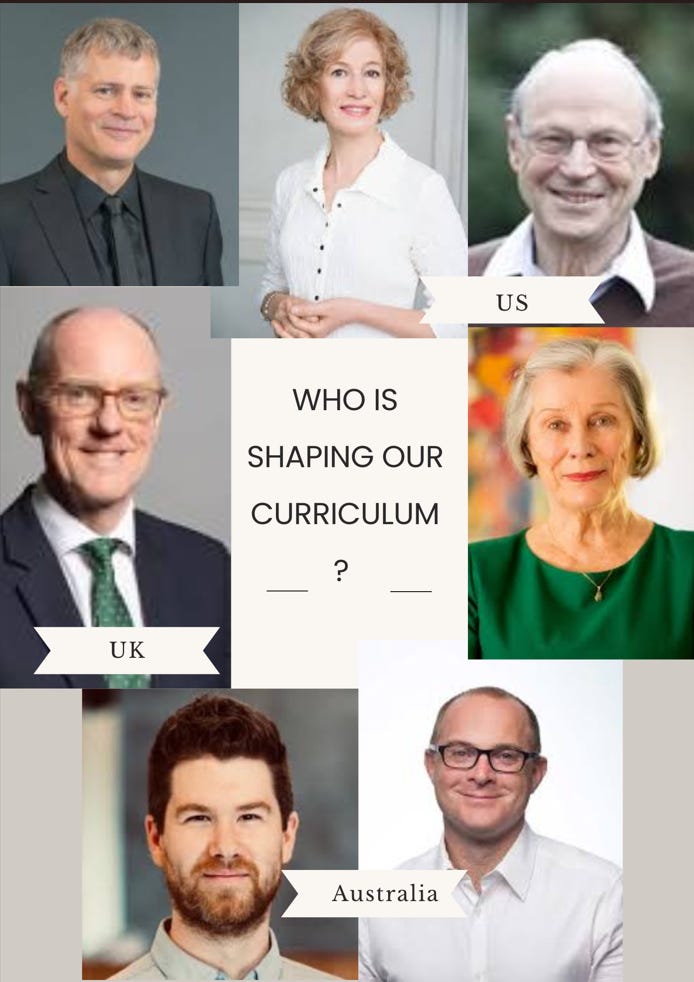
Figures like Elizabeth Rata and Michael Johnston are known to us, but the influence of international voices such as Nick Gibb (UK), Ben Jensen and Nathaniel Swain (Australia) and E.D. Hirsch and Natalie Wexler (US) is becoming increasingly significant.
The line up of speakers for next month’s Ministry of Education Curriculum Roadshow reveals many of the voices that our politicians and education officials are listening to.
Although E.D. Hirsch won’t be at the Curriculum Roadshow—at ninety-seven his traveling days are understandably limited—his influence will certainly be present in spirit. E.D. Hirsch is an American literary critic and educator who became a well known figure in education reform in the United States. He argues that true educational equity and success depend on a specific, knowledge-rich curriculum taught consistently to all students. His work has influenced education policy debates around the world, fuelling the “Core Knowledge” movement and inspiring a new generation of reformers who advocate for content-centered instruction over skills-based approaches. (For more about Hirsch and his influence on American education reform see: https://aecnz.substack.com/p/recording-what-is-behind-the-science )
Natalie Wexler is an education journalist from the United States. She is a prominent supporter and contemporary interpreter of E.D. Hirsch’s educational philosophy, as seen particularly in her book The Knowledge Gap. Like Hirsch, Wexler is critical of what they both see as an overemphasis on “skills-focused” or “child-centered” pedagogy. Wexler argues that the achievement gap is, in fact, a knowledge gap: and she breathes new life into Hirsch’s argument that a common, knowledge-rich curriculum is a mechanism for ensuring all children, regardless of their home environment, have access to the “cultural literacy” needed to succeed academically and participate fully in society. Not cultural literacy as we might define it in Aotearoa; this is about being literate in the culture and knowledge of the dominant group.
Nick Gibb is a British Conservative politician who served as the UK’s Schools Minister for much of the 2010s and early 2020s. He is best known for championing a “knowledge-rich” curriculum, phonics-based reading instruction, and traditional approaches to teaching, drawing heavily on the ideas of Hirsch. While praised by supporters for raising academic standards, he has also faced criticism for resisting calls to diversify or decolonise the curriculum. In a July 2021 speech, Gibb argued that children—including those from ethnic minorities—should learn the work of the “dead white men.”
Closer to home Australian Nathaniel Swain has amassed a following of Kiwi teachers and principals; he is a successful speaker and writer, and despite him not having extensive classroom experience many seem to have warmed to some of his ideas. Swain however frequently references and builds upon the work of E.D. Hirsch. His discussions highlight a strong alignment with Hirsch’s core principles, particularly the importance of a knowledge-rich curriculum. Swain’s own curriculum development work is directly influenced by Hirsch’s Core Knowledge Foundation. In a blog post about his school’s Read2Learn platform, he explicitly states that many of the units are based on Core Knowledge Units.
Ben Jensen is CEO of the Australian business Learning First, which is a consultancy/advisory group focused on education strategy, school and system reform, teacher/leader development, curriculum and evaluation.
He has advised governments internationally (Australia, North America, Europe, Middle East, Asia) on curricula, teaching and accountability among other things. Unsurprisingly, Jensen also acts as a key policy and implementation advocate for the educational philosophy pioneered by Hirsch. He is a vocal advocate for a knowledge-rich curriculum and critiques curricula that over-emphasise generic “21st-century skills” at the expense of specific, sequenced content. Erica Stanford’s ministerial diary reveals several meetings with Jensen over the past year.
It’s notable that these key individuals are all Pākehā, and few have direct classroom experience. Yet, their collective influence on New Zealand’s education policy appears to outweigh that of our own academics, teachers, principals and kaupapa Māori educators.
These influencers advocate for a Hirschian “knowledge-rich,” standardised curriculum, presenting it as a universal solution to educational disparities. Hirsch’s book The schools we need and why we don’t have them appears to have become the biblical playbook for education reform for education ministers Stanford and Gibb.
Where is Aotearoa in all of this? Where is te Ao Māori? Where is Fa’a Pasefika? Where is our local context?
Bruce Jepsen and Therese Ford have recently drawn our attention to the absence of Māori voice in current curriculum reform in their recent report written with the support of the PPTA: The Recolonisation of the Aotearoa New Zealand Curriculum in 2025.
They describe the dismissal of 50 years of curriculum progress under the policy of biculturalism as unbelievable…
The inferior status of Māori knowledge and people is reinforced by the MAG’s recommendations that Te Tiriti o Waitangi, our nation’s founding document, be removed from the curriculum and replaced with the science of learning. Additionally, it is difficult to fathom how this group has rationalised the exclusion of Te Tiriti while sanctioning the inclusion of 20 Shakespeare (from Elizabethan and Jacobean England) in the 2025 fundamental roadmap of teaching and learning in Aotearoa.
The recolonisation of the New Zealand Curriculum is not an inevitable outcome. It is a political choice that can be resisted through informed, courageous, and principled leadership. By protecting and advancing Te Tiriti o Waitangi, we can ensure that the curriculum truly serves all learners in Aotearoa, fostering a future where tangata whenua and tangata tiriti flourish and the promises of Te Tiriti o Waitangi are fully realised. This is not merely an educational imperative; it is a moral obligation for a just and equitable society.
Jessie Moss similarly, in her piece for e-tangata, asserts that anti-Māori, libertarian ideology is increasingly determining what our tamariki are, and aren’t, learning at school. https://e-tangata.co.nz/comment-and-analysis/ideology-is-pushing-maori-knowledge-out-of-the-curriculum/
Current curriculum reform and political ideology risk erasing decades of kaupapa Māori and Aotearoa-based research and teaching. They threaten to eradicate years of expert teaching where we have learned to let the uniqueness of the learner guide our work; nuanced pedagogy tailored to individuals and not delivered in bland one-size-fits-all approaches where teachers are no longer regarded as skilled professionals but as learning technicians.
As educational leaders in Aotearoa we need to wake up and critically examine the influences and voices shaping our curriculum right now. We must advocate for a curriculum informed by local educational experts that truly serves all our students. A curriculum designed by New Zealanders for New Zealanders.
Please don’t call these insidious individuals Pakeha. That is an identity that has to earned. Knowledge-rich should be in inverted commas. As I have commented on in the site, the reality is knowledge impoverishment. You simply have to look at what’s left out: local knowledge, indigenous knowledge, socio-cultural understandings of learning, critical literacy. And that’s just for starters
The emphasis on "knowledge" (especially ole white man knowledge) is really short-sighted especially at a time when AI flourishes: skills-based education is more vital now than ever before. What are we doing!!? (or allowing to be done to us?)