

500 versus 95,000
On minorities, majorities, and who the Minister is choosing to hear

The Education Minister says opposition to the curriculum rewrite is a “vocal minority.” The numbers tell a very different story and they raise a more pointed question about who is actually listening to whom.
When the Education Minister was asked this week to respond to a wave of opposition from teachers, principals, subject associations, iwi and researchers, she had a ready answer.
“I was at a conference on the weekend,” she told RNZ on 6 May. “500 teachers and principals from around New Zealand who are there to learn about the science of learning and implementing it in their schools — hugely on board. My view is that it is a quite vocal minority that are opposed to these changes.”
Let’s look at that claim carefully. Because if the Minister is genuinely making policy decisions on the basis that organised, evidenced, sector-wide opposition constitutes a fringe, then we have a serious problem. Not just with the curriculum, but with how this government understands consent.
On the Irony of the ‘Vocal Minority’
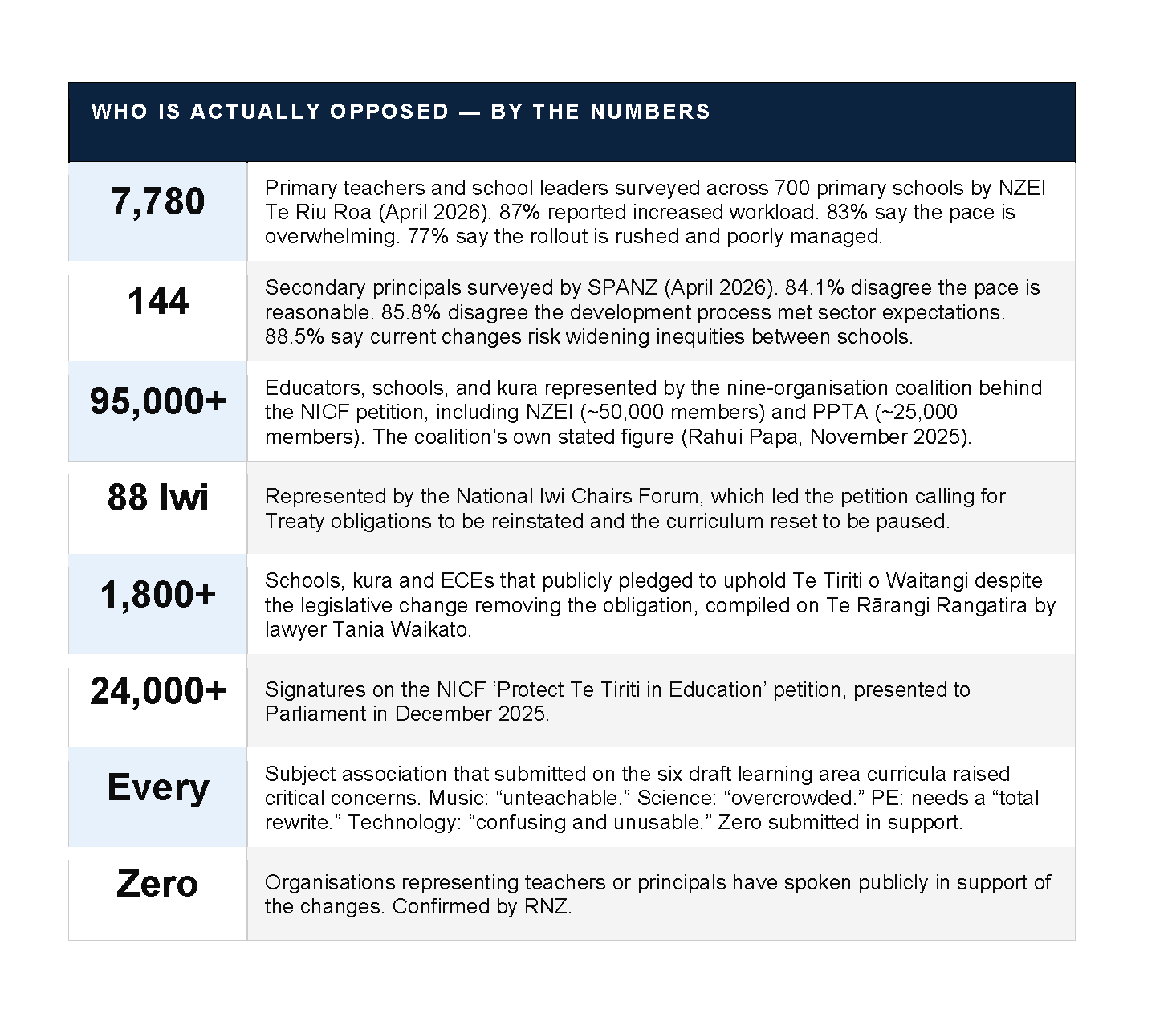
The Minister used the phrase “vocal minority” to describe the thousands of educators, iwi, subject associations and legal bodies raising alarm about her curriculum. But look at what she is actually doing: citing 500 self-selected attendees at a specialist conference to override the organised, evidenced concerns of 95,000 educators and 88 iwi.
If there is a vocal minority at work here, the numbers suggest we need to look more carefully at who is doing the listening and who is being ignored.
The Minister is not listening to the sector she is supposed to lead. She is listening to the 500 people who already agree with her and calling the other 95,000 a minority.
The Conference Versus the Evidence
Let’s start with the comparison the Minister is inviting us to make.
On one side: 500 teachers at a weekend science of learning conference, self-selected and philosophically aligned with the government’s direction. On the other: a survey of 7,780 primary teachers across 700 schools, finding that 87% reported increased workload, 83% say the pace is overwhelming, and 77% say the rollout is rushed and poorly managed. And a separate survey of 144 secondary principals by SPANZ, finding that 84.1% disagree the pace of change is reasonable, 85.8% disagree the development process met sector expectations for engagement and consultation, and 88.5% agree that current changes risk widening inequities between schools.
These are not the findings of a fringe. These are the findings of a profession. Primary and secondary, teachers and principals, in acute and documented distress.
On The Conference Itself
Let’s be more precise about who was in that room.
The conference the Minister attended was a science of learning event. A professional gathering organised around structured pedagogy, knowledge-rich curriculum, and explicit instruction. This is not a neutral educational space. It is a community with a specific and contested philosophical position on how children learn and one that happens to align closely with the direction the Minister has been driving.
These are, in the plainest possible terms, her people. They share her framework. They came to a conference specifically to deepen their commitment to an approach that the new curriculum is designed around. Using their enthusiasm as evidence of broad sector support is a little like conducting a satisfaction survey at a political party conference and reporting the results as a poll.
The science of learning framework is itself the subject of ongoing debate within the profession. What is not in debate is whether one weekend with 500 of its adherents constitutes a mandate to override the organised, evidenced, cross-sector objection of tens of thousands of educators. These include the very experts in Māori education, specialist schooling, and subject pedagogy who know, in granular detail, why these particular drafts are failing.
This matters because the Minister used this room, this specific, philosophically aligned room, to dismiss the concerns of 7,780 surveyed primary teachers, 144 surveyed secondary principals, every subject association in the country, 88 iwi, and a Waitangi Tribunal hearing as a “vocal minority.” That is not a reading of the evidence. It is a substitution of the evidence.
What The Spanz Survey Adds
The SPANZ Principal Pulse Survey, conducted in April 2026 with 144 secondary school principals, confirms that the pattern of opposition is not limited to primary schools or teacher unions. It spans the full secondary sector too.
85.7% of secondary principals disagree with the removal of the requirement for school boards to give effect to Te Tiriti o Waitangi. 82.8% disagree that the curriculum honours Te Tiriti. 84.2% disagree that they can attract and retain enough quality teachers to implement the changes. And 76% disagree that the draft curriculum documents are fit for purpose and meet the Ministry’s own stated standards.
Particularly striking: when asked whether the knowledge-rich and explicit teaching focus - the very philosophical foundation of the science of learning conference the Minister attended - is a positive direction for the curriculum, 31.3% of secondary principals had no clear view yet. The remainder were split. This is not a sector that is “hugely on board” with the framework underpinning these changes. It is a sector still asking fundamental questions about them.
What The Open Letter Actually Said
On 20 April 2026, a full-page advertisement was published in Stuff. Signed jointly by NZEI Te Riu Roa and the New Zealand Principals’ Federation, alongside dozens of regional associations, university academics, and subject associations, it made five specific charges, not vague opposition, but named claims.
That the curriculum does not honour Te Tiriti o Waitangi. That the development process ignored teachers, iwi, hapū and whānau in favour of “the narrow ideological interests of a small group.” That the pace is unreasonable and schools have not been adequately resourced. That the draft documents do not meet the Ministry’s own standards. And that in many education settings, the curriculum is simply unworkable.
These are not the claims of people who haven’t read the documents. They are the claims of people who have read them, taught from them, and found them wanting.
The Waitangi Tribunal Is Not A ‘Vocal Minority’
The Waitangi Tribunal is a permanent commission of inquiry established under New Zealand law to make recommendations on Crown actions affecting Māori rights. When it convenes an urgent hearing, as it did in April 2026, brought by Ngāti Hine, Te Kapotai, and NZEI, it does so because it has assessed the claim as sufficiently serious to warrant urgency.
Evidence heard included testimony that Māori were not consulted “appropriately” in the development or co-construction of the new curriculum, and that Ministry advice recommending no changes be made to Treaty obligations without first engaging Māori was disregarded. Te Akatea told the Tribunal these changes risk eroding progress in Māori education by 50 years. Ngā Kura ā Iwi o Aotearoa, representing 53 iwi schools, told the Tribunal the Crown had not acted from a tātou (inclusive) position but from a mātou (exclusive) one.
These are not minority voices. They are the voices of the people whose tamariki this curriculum is supposed to serve.
What We Are Asking
What we are asking is simple: that the scale of concern be named accurately.
When 95,000 educators, 88 iwi, every subject association, and a Waitangi Tribunal hearing all raise the same alarm about pace, about process, about Treaty obligations, about content quality, the accurate word for that is not “minority.” It is consensus.
A government that dismisses consensus as noise does not build better schools. It builds resentment, attrition, and the kind of partially implemented reform that international research has repeatedly shown to fail.
The AEC calls on the Minister to engage with the evidence, all of it, and to begin from the position that the people who turn up to teach every day, who know their tamariki, who have read these documents and found them wanting, are not the opposition.
They are the system.
It is academia I have a dispute with not teachers. During the 'reading wars' in which my family were heavily involved it was academics and the Ministry we blamed for the reading failure and the indoctrination into progressive ideology.. Being a third generation teacher in my family , I am familiar with the changes for the entire 20th Century in NZ education.
While attending Teachers Training College , I was tutored by experienced teachers who were from the pre -progressove era. The methods they taught were highly structured and we had hours of classroom management . There was very little theory. ' Old school' teachers held onto their methods for decades despite losing promotion , because they saw they worked.
We had a number of highly competent teachers secretly bring their own children to our school room for remediation . These included Reading Recovery teachers and a Scottish professor of education who had failed to teach her own family member to read.
If i achieve nothing else in this blog , but establish that simply reading to children will not ensure
literacy . I will feel I have achieved something . All the children we had for remediation had been extensively read to as pre-schoolers. What is needed is knowledge of letters and sounds .
The performance of NZ students at both primary and secondary level has declined sharply since 2009 and also the students at the highest level s have declined sharply as well. There is a persistant huge gap between students of different socio-economic status .-one of the worst in the developed world. Maori and Pasifica have been impacted by this hence contributing to their poor stats in welfare , prison and menial work. I grieve about this having remediated many Maori students in the basics using structured methods.
My anger is directed at the academic who was infatuated with Marie Clay 's progressive and constructivist Whole Language reading method . We could have had then the changes occurring now in structured learning but he dominated the 2000 Parliamentary enquiry into NZ literacy . Pro -phonics academics were not even given speaking rights at this enquiry . Hundreds if not thousands of submissions called for change . This change to structured learning has occurred earlier in other countries . We had to see even more failure , more children's careers ruined before change occurred. here.
Very well analysed - support vs non support .
Thanks.